
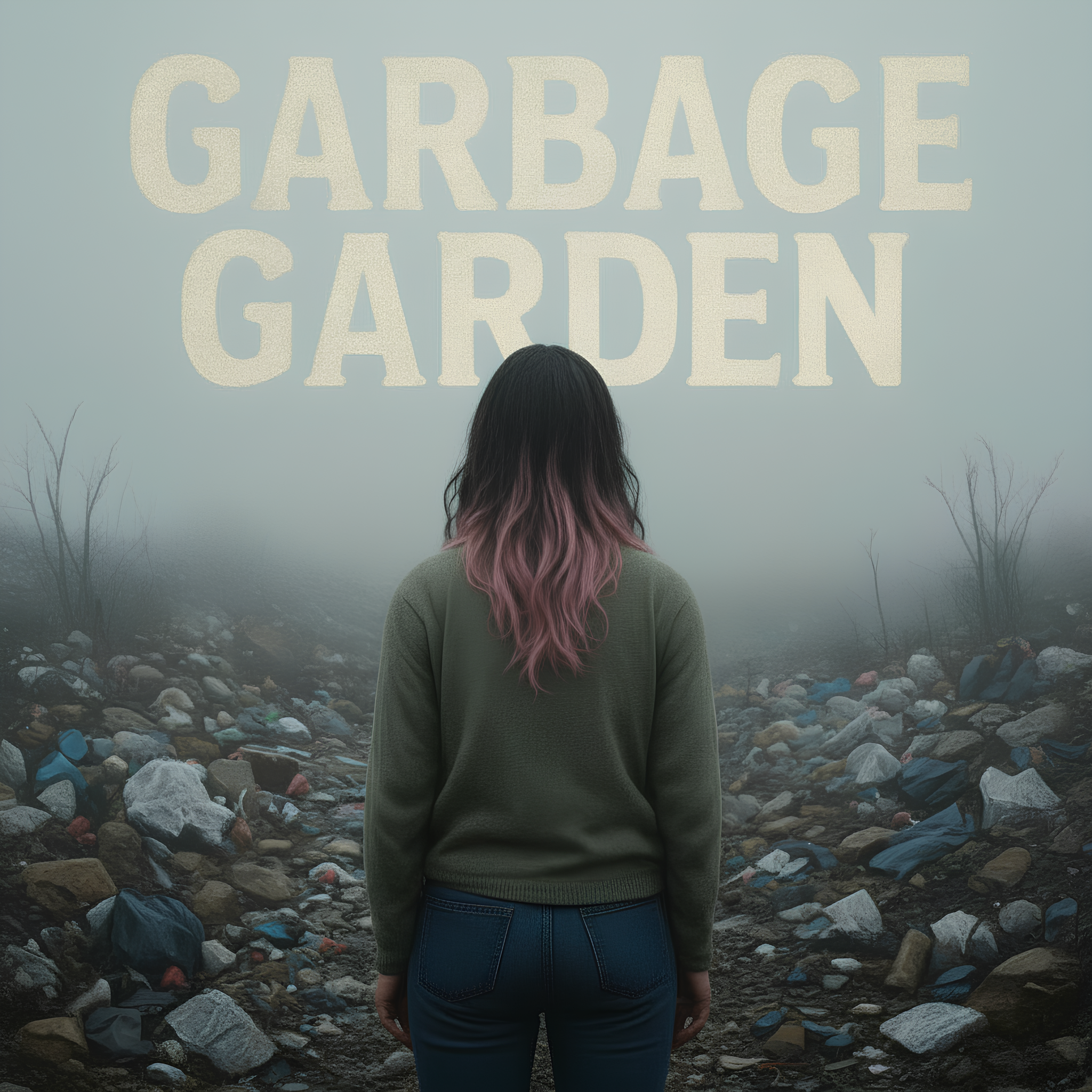
Photo: Garbage Garden
In a world that often rewards speed, noise, and constant output, this artist moves in the opposite direction—into stillness, space, and what they describe as the “silent voids of our era.” Their latest project, busy. being. Real., is not just a collection of songs, but a reflection on identity, pressure, and what it means to exist outside the systems that try to define us. Blending immersive, cinematic soundscapes with deeply introspective themes, the work invites listeners to pause, observe, and recognise something of themselves within it. We spoke about voids, truth, and the quiet defiance of being real.
Your work often centres on what you call the “silent voids of our era,” while ‘busy. being. Real.’ focuses on stepping away from societal expectations. How do those two ideas connect within your overall vision?
Thank you for the thoughtful question. To explain the connection, I’d like to mention my previous work, ‘name[I]ess.’ In that project, I explored the idea that true freedom comes when you abandon everything—the scoreboard, the critics, and the social frames. I described it as a state where the ‘judges’ dissolve, and you are left with an ‘unmeasured silence.’ That is what I call the ‘silent voids of our era.’ It isn’t a place of loneliness, but a sanctuary where social pressure cannot reach.
In ‘busy. being. Real.’, this idea evolves further. As the lyrics say, ‘I’m building a garden in the void.’ Stepping away from societal expectations isn’t just an escape; it’s an act of reclaiming that ‘void’ as my own territory.
While the world sees the ‘void’ as something empty or scary, for me, it is the only place where I can find my own sanity and ‘The New Physics.’ So, these two ideas are deeply linked: the ‘void’ is the space I’ve found, and ‘being Real’ is what I am busily doing within that space, free from the gravity of a ‘perfect system’ that was actually a living hell.
The title ‘busy. being. Real.’ feels quietly defiant. What does “being real” mean to you in a world that often rewards efficiency over authenticity?
To me, ‘being real’ is the act of reclaiming my existence from a system that treats efficiency as a religion.
The world expects you to be ‘productive’ 24/7, like a subscription service that never ends. In that context, choosing to step off the conveyor belt might look like failing or being ‘lost.’ But the title ‘busy. being. Real.’ is my way of flipping that script.
I am not idle. I am incredibly busy—not with fulfilling external tasks, but with the exhausting work of unlearning a pre-determined gravity and building my own sanity from scratch. If being ‘Real’ is defined as being ‘inefficient,’ I accept that. It means I have finally become authentic enough to be independent of the system.

You explore heavy themes—Childhood Emotional Neglect, generational disconnection, forgotten lives—but present them through vibrant, almost immersive soundscapes. Why is that contrast so important to your identity as an artist?
There are a few reasons for this. First, through my experience in various music communities, I’ve realised that when a track feels overly heavy or serious from the very first note, listeners often disengage before the message can reach them. That’s why I prioritise sounds that are engaging and immersive right from the start — to draw people in and give the lyrics space to resonate on their own.
In ‘busy. being. Real.’, I leaned even more into vibrant, almost cinematic soundscapes with hyperpop and psychedelic digital textures. But this doesn’t mean every track of mine is like that. My overall body of work tends to explore a wider emotional palette — sometimes colder, more detached, or restrained — depending on the story I want to tell. The important thing is the contrast. I use that tension between the sonic brightness and the underlying weight of the themes to create an ‘emotional void’ where listeners can project their own experiences.
More importantly, I see my work as a ‘mirror.’ My identity isn’t about preaching or giving direct answers; it’s about creating a high-definition frame where listeners can see their own thoughts reflected. This is why I often rely on metaphors and ‘voids’ rather than blunt declarations. Ultimately, whether the surface is vibrant or subdued, what matters is that the frame remains clear enough for the listener’s truth to shine through.
Critics have highlighted the emotional shift around the 2-minute mark in ‘busy. being. Real.’. What’s happening narratively or emotionally at that point in the track?
The shift around the 02:08 mark—specifically during the segments for ‘the waiting ghost’ and ‘the gears will snap again’—was a very deliberate directorial choice.
Narratively, this is the moment where the cold, restrained observation begins to surface. Throughout the track, the vocals remain detached, as if watching a machine from a distance. But at this point, the suppressed realisation emerges: the realisation that past tragedies aren’t just relics of the past, but cycles waiting to repeat.
Emotionally, it marks the transition. This section captures the point where what has been held back can no longer stay contained. It is the sound of the ‘gears snapping’—not just in the system, but within the individual’s psyche. It is the shift from quiet observation to a direct encounter with the ‘Real.’
Your project draws inspiration from Japan’s “Lost Generation,” yet remains open-ended and globally relatable. How do you balance cultural specificity with universal meaning?
My partner belongs to Japan’s ‘Lost Generation,’ and for over 20 years, I have observed their lives up close—not just as a ‘social problem’ portrayed in the media, but as individual realities. Through my time living in various parts of the world during my 20s and 30s, I realised that this sense of ‘loss’ is no longer exclusive to Japan. This is why I felt it was important not to limit this story to a specific geography.
For instance, the line ‘a 24-hour subscription’ was inspired by a famous 1990s Japanese energy drink ad that asked, ‘Can you fight for 24 hours?’ To me, that aggressive productivity of the past feels eerily similar to the ‘subscription-like’ exhaustion of today’s global life. Similarly, the imagery of the ‘evaporating floor’ might feel like the post-bubble collapse to a Japanese listener, but it can represent any sudden loss of stability to someone else.
I intentionally used these metaphors and ‘voids’ to ensure the track didn’t sound like a direct plea to ‘understand Japan.’ I personally dislike categorising people into ‘generations’ because every life within the ‘Lost Generation’ is entirely distinct. By avoiding a specific grievance, I wanted to create a space where anyone can find their own reflection in the music.
There’s a strong sense that your music doesn’t want to “fix” anything—it simply observes and gives space. Do you see your role more as a documenter of emotional truth than a storyteller?
Yes, I absolutely see my role as a documenter or a ‘Mirror Maker’ rather than a storyteller. I don’t believe I have the right to ‘fix’ someone’s life or ‘represent’ their pain. My goal isn’t to teach or provide answers. Instead, I want to capture and document the existence of those who are often overlooked—those deemed ‘less valuable’ by a world that only rewards what stands out.
I believe my music should function as a mirror. Rather than telling a scripted story, I want to provide a space where listeners can encounter the thoughts and emotions they already possess but have yet to reveal. My role is simply to provide a vivid, high-definition frame; what is reflected inside that frame is ultimately the listener’s own truth.

You’ve described your sound as “sad but not mournful.” How do you approach writing music that holds pain without being consumed by it?
I’ve always found music that forces sadness through overtly mournful melodies to be somewhat manipulative. As an observer, I prefer to ensure that emotion does not dominate the entire track.
Instead, I strive to create an ‘emotional void.’ By maintaining a certain distance—a coldness or even a playful surface—I invite the listener to step in and explore their own depths. To me, holding pain without being consumed by it is about contrast. This tension prevents the music from sinking into self-pity and keeps the message authentic.
The project blends Alternative Metalcore with psychedelic digital textures in a way that feels almost cinematic or game-like. How intentional is that immersive, “world-building” aspect?
To be honest, I’m not sure if ‘intentional’ is the right word—it feels more like an instinctive expression. Before I began making music, I spent the early 2000s as a game designer, and for the past two decades, I’ve worked as a professional game translator. More than half of my life has been deeply immersed in the language of games.
As I mentioned regarding the contrast in my sound, my approach is to first draw the listener into a vivid sonic world before they even notice the underlying message. Because of my background, building that world feels natural to me. I create music with the soul of a world-builder who still yearns for that creative process. The ‘game-like’ immersion isn’t a calculated tactic; it’s simply the way I’ve learned to construct reality—by providing a high-definition space where the listener’s own story can finally unfold.
Your music deserves more than $0.004 per stream… Get our FREE guide – instant download.
From ‘Tabula Яasa’ to ‘busy. being. Real.’, there’s a thread of reclaiming identity from systems that overlook people. Is this an ongoing narrative you’re consciously building across releases?
When I began the ‘Not to be Lost’ series, my intention was to tell ‘the stories of others.’ However, it’s fair to say that I feel a slight personal connection to both sides of these stories. While they aren’t strictly my own autobiography, these inspirations have been passed through ‘my own filter,’ so fragments of my own self are naturally embedded within them.
The theme of ‘reclaiming identity from systems that overlook people’ actually finds its roots in a track I released last December called ‘Garbage Garden.’ That song was the starting point for this exploration—the idea of existing as a ‘version they couldn’t invoice’ and finding freedom the moment the system throws you out. This narrative has naturally evolved through ‘Tabula Яasa’ and ‘busy. being. Real.’, forming a continuous thread of resisting the outdated frames that try to define our worth.
For listeners who feel “slightly displaced” or disconnected from the systems around them, what do you hope they recognise—or perhaps realise—when they hear your music?
I’ve always been cautious about saying things like, ‘You’re not alone’ or ‘Everyone feels the same way.’ While that realisation can be positive when found personally, hearing it from someone else can feel dismissive—as if your unique pain is being minimised into something common. I’ve never intended to broadcast that kind of message.
However, I do believe that the sense of displacement itself is a vital piece of who you are. That psychological distress is, in a way, proof that you are looking at yourself directly and honestly, rather than fading into the background of the system. So, to answer your question, I lean toward the latter: I hope listeners recognise that their disconnection isn’t a flaw to be fixed, but a sign of their own ‘Real’ identity surfacing. It is a testament to the fact that you are still there, resisting the mould.
https://linktr.ee/garbage.garden
https://x.com/GarbageMusic_SN
https://open.spotify.com/artist/46Vwy9J73rIhOy0pHiW8Ix
https://soundcloud.com/discover
https://www.youtube.com/@GarbageGarden_Official
https://www.instagram.com/garbage.garden.sn/
FVMusicBlog March 2026
If you would like to submit your music for a playlist or review consideration, please submit here.
Also! Check out the awesome other artists on the ‘Discovered This Week’ Playlist!

Leave a Reply