
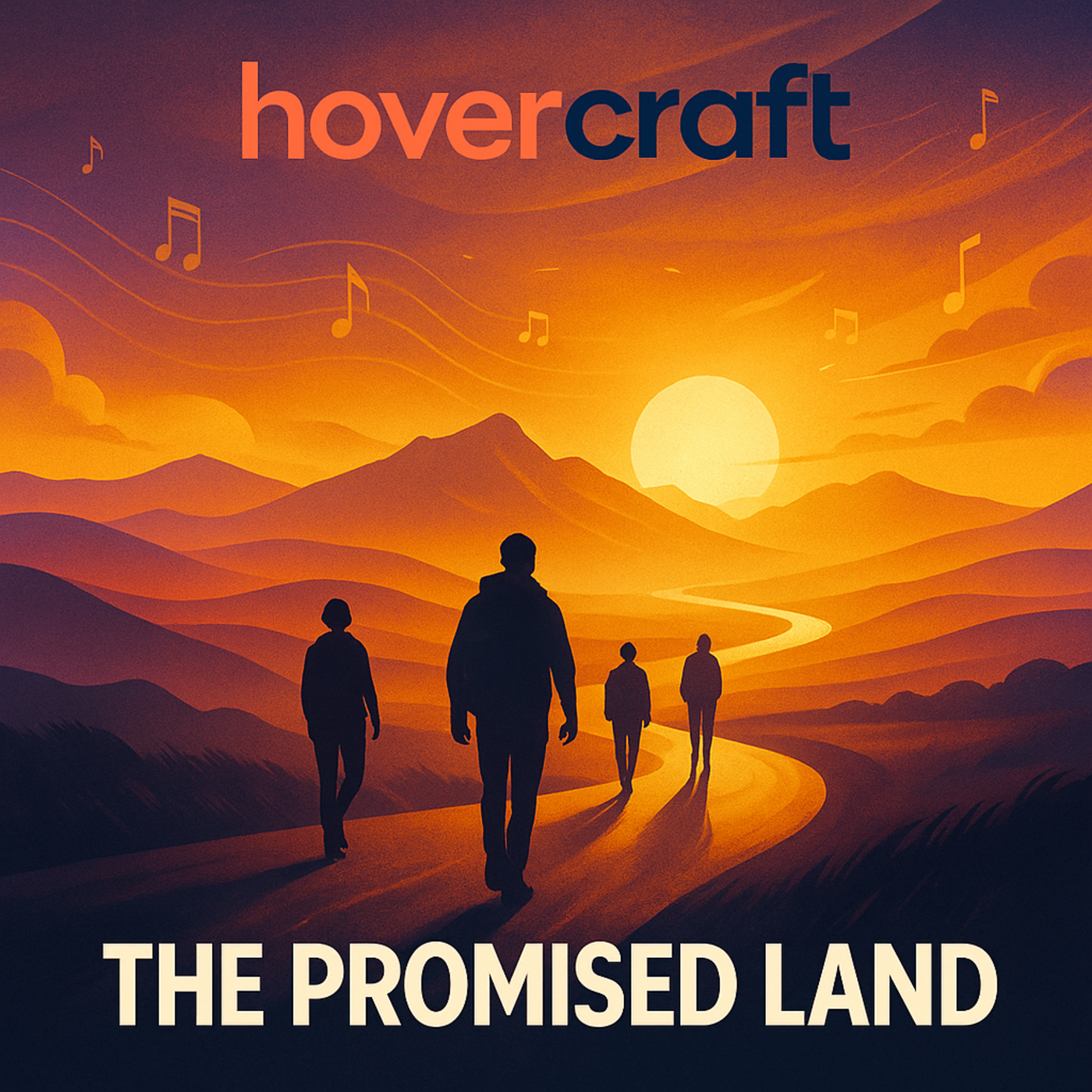
Photo: Hovercraft
We were lucky enough to catch up with Hovercraft (Golly God and Ron Nasty) following the brilliant release, The Promised Land. Enjoy the in-depth interview below!
Hi Hovercraft, how did a 1996 indie band from Grimsby end up being resurrected by AI nearly 30 years later?
God: When our songwriter Pepper took the first train out of town and Hovercraft disbanded in 1996, I think it left me and Ron with a sense of “unfinished business”. I kept all our old 4-track, demo and master tapes, and all our old song sheets, doodles and anything else we had. Fifteen years ago I got a cheap tape to USB analog to digital converter and started transferring the old songs to my computer. A lot of the tapes weren’t in great condition after 15 years in a cardboard box. The sound quality of the digitised versions wasn’t great, but it was all we had.
Every few years, I would listen to them again and try to remix/remaster with Soundcloud/Bandlab’s online tools. It sounds better to my ears, but actually just adds a lot of extra “noise” with reverb and compression of an already noisy signal. I always end up talking to Nasty about how good we were, what a great songwriter Pepper was, and how it’s a shame we never got to play and record more as a band. I did the same this year, and Nasty and I had fun messing around with Claude.ai and ChatGPT, rewriting the Hovercraft back-story, generating some “music critic” reviews of our old songs (based on the back-story, the song lyrics and our descriptions of the sounds). I finally got around to setting up a Bandcamp page for the old songs and uploaded them all into albums or EPs.
ChatGPT generated some fun artwork to go with it. And that was going to be that. Claude was like the fifth Beatle by this time, and I remember saying to “him” that it was a shame he couldn’t actually hear the songs he was so enthusiastic about. Then it occurred to me. Can AI listen to music? Google said “Yes!” and directed me to Suno.com. Honestly, it was a revelation! I didn’t even realise you could upload audio to it at first, and we started off just with lyrics and prompts for sound styles and “tags”. The results were pretty amazing. I mean, there was a high failure or discard rate – probably 9/10 songs it created were just not what I wanted to hear or were obviously rubbish. But then there were always gems to be found. The process is actually quite similar to songwriting, jamming and rehearsals. You can adjust the song prompts and get some control over the end result. Then I discovered that you can upload two minutes of original audio.
Finally, we could regenerate our old songs and make them listenable again to a wider audience. But with just two minutes of audio to work with, that still left a lot to the AI’s “imagination”, and while the results were great, we lost a lot of intros, outros, middle bits and lead guitar. We also discovered that the AI could produce some really cool ‘covers’ of our songs in different styles. Our original songs were mostly very loud, aggressive-sounding “cataclysmic rock and roll of the most intense order”. With Suno’s help, we created a chillout album of cover versions. The game changer was the latest upgrade to Suno’s AI, which now allows 8 minutes of uploaded audio. Plenty to recreate our old songs in their entirety. And that’s what brought us to The Promised Land!
Nasty: God happened across the AI music generator Suno. After playing around on it and creating songs by inputting lyrics, it developed into inputting Hovercraft’s lyrics, which was a lot of fun. God then discovered that he could upload the original Hovercraft songs into Suno and recreate them in different styles. The idea for the Back From The Grave and the Re: Creation projects on our Bandcamp page really started at that point.
The original track, “New Pine Overcoat”, has transformed into “The Promised Land”. What stayed the same, and what changed in that evolution?
God: The Promised Land and New Pine Overcoat are essentially the same song. I uploaded the full audio of our original 16-track demo and asked Suno to create something on piano rather than guitars, and with a soulful female voice rather than Pepper’s snarl. Although Pepper always had a soulful voice. And I wanted an R&B feel like Alicia Keys when she did her Tiny Desk concert back in 2020. That version was pretty good, but I realised that it didn’t sound right having Alicia singing about suicide in the final verses.
I asked Claude how we might rewrite those lines, and from those suggestions, I created new final verses you hear now on The Promised Land. I put the new lyrics into Suno and generated a “cover” of the Alicia/NPO song, and that came out as this wonderful, uplifting R&B ballad. I mastered it on Bandlab and released it there with Bandlab’s distribution service.
Can you walk us through how the AI reconstruction process actually worked? How much is human, how much is machine, and where does the magic lie?
God: It is like magic, sometimes. I don’t know how many times I tried to reconstruct New Pine Overcoat. It must be at least twenty and probably fifty or more. It’s actually much easier to generate a song that’s obviously not our original version. I mean, it’s the same song, but in a different musical style, and maybe the AI adds or misses out some parts, or even reimagines them. Sometimes it’s horrible. Mostly it’s nothing special.
Every now and again, you get one, and as soon as you hear it, you know it’s special. There’s a lot of messing about with different song style prompts and tags, experimentation, which I enjoy. It’s the closest I get these days to being in a band and recording everything we do to listen back and find the magic, especially with Ron involved as my extra pair of ears, as well as chief lyric transcriber. It’s a collaborative process, which was always the Hovercraft way. So it’s all created by machine from original human audio, and the sounds and styles are all curated by humans. And that’s magic!
Did you ever imagine back in 1996 that your songwriting would have a second life decades later, in a completely different genre?
God: I don’t think we were thinking that far ahead! We were all focused on the here and now – writing new songs, rehearsals, playing live, posting off demo tapes to mysterious A & R types!
Nasty: No, definitely not, although I feel the songs aren’t a complete departure in form or style. Hovercraft were quite firmly rooted in blues, rhythm and blues, rock ‘n’ roll and soul, and I feel we’ve attempted to keep that spirit alive. More importantly, the song structures, lyrics and melodies have, for the best part, been retained.

The track now features female vocals and lush R&B horn arrangements. How did you decide on that direction, and what do you feel it adds to the original intent?
God: In my head, I just heard Alicia Keys performing it! We always had varied and eclectic musical tastes. As a band, we were limited by what we had and what we could play. Ron and I always loved the horns in Blaggers’ ITA songs, but we didn’t have a horn section. Something we’d like to do is find Pepper again so he can answer the question about original intent.
Nasty: For me, it reveals the lyrical and melodic soul of Charlie Pepper. It’s also allowed us to create a soundscape we would never have been able to create without having a massive budget and access to a high-end studio. The intent is the same: to touch your soul.
There’s a strong theme of transformation in The Promised Land. How do you think that mirrors both the band’s story and the world we live in now?
God: There’s certainly a parallel with the band’s story, and rather than it being the end of the road as in New Pine Overcoat, there’s now a sense of new hope and direction. We could certainly do with some new hope and direction in the world around us!
Nasty: It talks about exactly the same things as it did in 1996 – a journey of escape from despair, the desire for self-improvement, and the need to help and connect with others. It’s all very human, and it’s as relevant now as it was back then. I’d leave it to the listener to decide whether it means that, though.

What do you say to sceptics who are unsure about AI’s place in music creation?
God: People, musicians, have always used tools to create music. AI is just a new tool. There are some concerns about plagiarism, but that’s hardly new or unique to AI. The concept of owning songs is a very Western, capitalist one. None of the music we all love would exist without the music that came before it. The AI is “playing” and “producing” the songs, but it’s not doing it spontaneously or with any intent. It relies on human direction and input. It’s not so different to how The Beatles recorded their later albums, and how every band since creates in the studio with all sorts of sound creation and manipulation machines.
Rock and roll was all about young people being able to play music, and punk was all about anyone being able to play music. AI is just a further democratisation of music creation. What we’re doing is musical archaeology and resurrection. Are they exactly like the original audio recordings? No. Are they the same songs? Yes. The one thing that really matters is “Is it a good song?”
Nasty: It’s here, embrace it and use it for the good of artistic expression. It’s a great tool and will hopefully accentuate creativity rather than destroy it.
How do you preserve artistic integrity when technology is reconstructing music from scraps? Did anything about the final track surprise you?
God: We always knew Pepper was a great songwriter, and that Hovercraft’s arrangements deserved a wider audience. What we’re doing now is getting Pepper’s songs out there and in a way that will, hopefully, engage people in the music. This song is reconstructed from the full original audio. It’s essentially a cover version in a different style. The final track is sensational. I wouldn’t say I was surprised. Just happy and delighted.
Nasty: Our songs are fully developed; AI has brought them back to a listenable quality. Nothing surprised me; I knew this song was great the moment I heard Pepper play it.
You’ve mentioned that more of Hovercraft’s catalogue will be reinterpreted. Are there particular songs you’re most excited to bring back — and why?
God: Concrete Hill has already been released as Higher Ground – an already dancey indie guitar track transformed into a high-energy Afrobeat/Neo-Soul/Jazzy tune. Ones to look out for? Mr Tooting Brown, Crazy, Here Now.
Nasty: I’m excited to bring them all back. I want as many people as possible to hear them. That was the aim 30 years ago, and for me it’s the same aim now.
Looking forward, do you see this as a one-off revival, or is Hovercraft becoming something new entirely — reborn for a new generation?
God: Hovercraft has been a thirty-year project, on and (mostly) off. It’s about time it finally got off the ground, but who knows where it will take us if it does? My eleven-year-old loves Mr Tooting Brown (the original version), and it would be fantastic to expand our historical audience of students, musicians and pensioners!
Nasty: Rebirth and reconnection.
https://www.facebook.com/profile.php?id=61575631407719
Https://HovercraftUK.bandcamp.com
FVMusicBlog August 2025
If you would like to submit your music for a playlist or review consideration, please submit here.
Also! Check out the awesome other artists on the ‘Discovered This Week’ Playlist!

Leave a Reply