
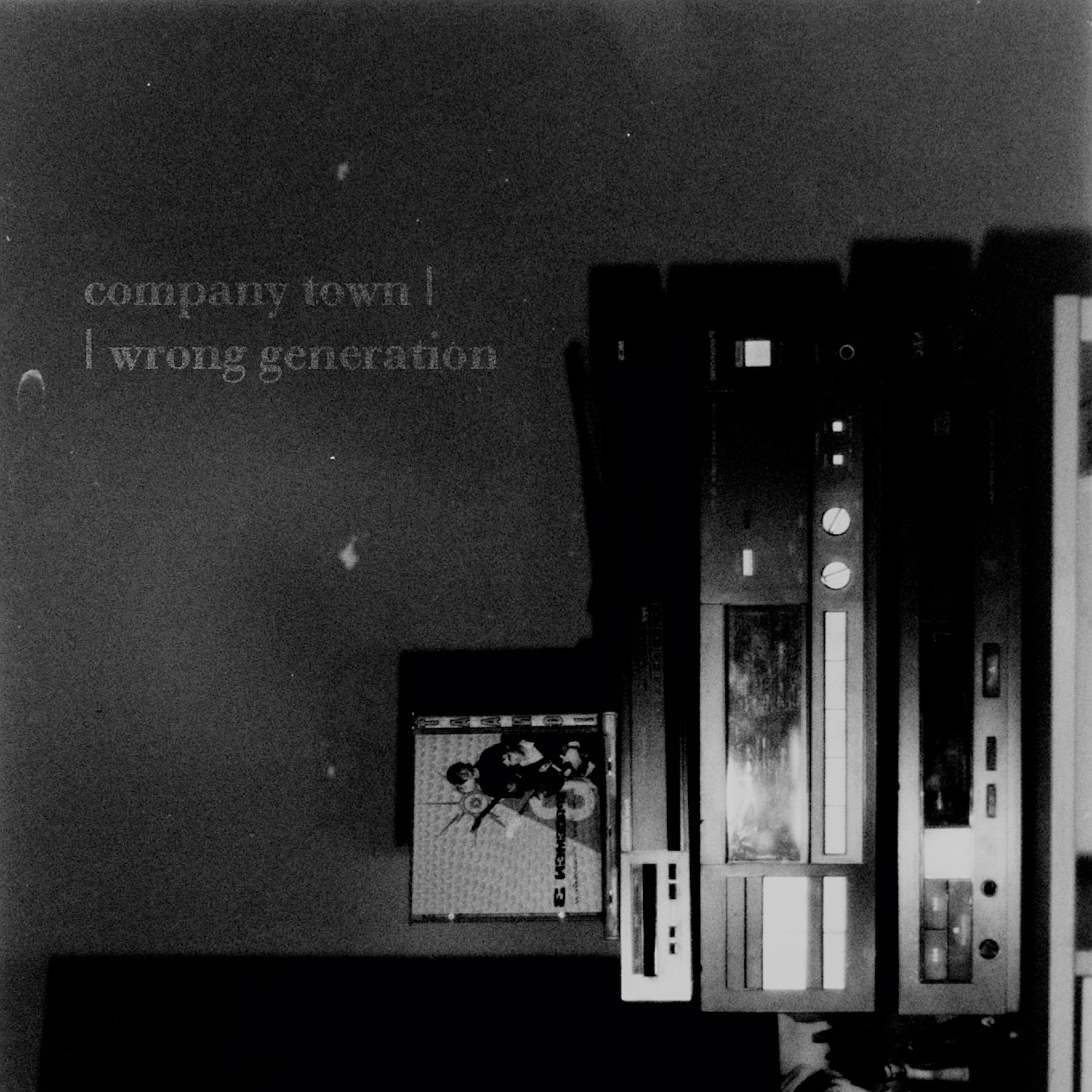
Photo: Company Town
Rooted in longing, memory, and a deep resistance to disposable culture, Company Town emerges as a project that feels both excavated and newly formed. Built around the concept of anemoia—nostalgia for places, eras, and lives never personally lived—its debut EP Wrong Generation drifts through fragments of history, voices from the past, and emotionally charged soundscapes that refuse easy categorisation. In this conversation, the artist reflects on nostalgia as a creative force, the role of sampling and memory, and the quiet defiance of making deeply human work in an age of speed, automation, and endless scroll.
Company Town is rooted in the idea of anemoia—nostalgia for a time you never lived. Where did that feeling first show up for you, and how did it shape this project?
I don’t know exactly when it first showed up for me, but I know it’s always been one of the most profound emotions in my life. It’s something I experience very regularly – whether it’s reading about a certain time or place, or thinking about life in a time removed from the constant inundation of technology we’re now forced to reckon with. And I think a lot of people feel that, but I also feel nostalgia and anemoia in totally mundane moments. Scenes of urban decay and deindustrialisation. I love riding the train through New Jersey, looking out the window at all these different towns I’ve never lived in or visited. And I feel this profound longing and nostalgia so intense that it almost feels physical as well as emotional.
So, I guess I’ve recognised over time that nostalgia is an unusually strong feeling for me, and I’ve always channelled it into any music that I create. But this project feels like the next level. It’s been very cathartic, in a way, to channel some of that energy into the music I’m making. And nostalgia shapes this project in every way, both in the samples that I’m drawn to and the sonic decisions I make. On the sampling side, I love the experience of hearing something and trying to sort of understand where it came from, what those people were doing, when, and how. And then, when it comes to putting my songs together, the feeling is deeply tied to every decision I make about production and the music’s sonic character.
Wrong Generation feels like a manifesto as much as a debut. What were you trying to declare—musically or personally—with this first release?
It’s funny you say that because I feel that way about this EP too. This is a project I’ve worked on every day for just about a year now. And I really wanted the EP to showcase a few of the directions that I’ve taken and just give a decently accurate picture of the different approaches I’ve used that come together to make this what it is.
At the same time, the lyrics and voice samples on this EP are really important to me – particularly on In Your Imagination. I think that song says a lot lyrically (if that’s the word). When it opens, the first clip you hear – “the older people go there for the nostalgia of it all… and the younger people, it’s something new for them, they’re discovering it for the first time” – that lays out a lot of what’s important to me about doing this. It can be both a nostalgia trip and a trip of discovery, of new experiences and breakthroughs. Hopefully, some listeners experience some of that as well. When I talk about this idea of being rooted in nostalgia, one might take that to mean that I’m just doing a throwback thing – I’m doing a pastiche of some sound from a long time ago – but that’s certainly not what I’m trying to do here. I just find it really important to embrace and acknowledge the whole history of music, art and philosophy that has influenced who I am as a musician. And then that song ends with a fantastic 90-ish-second monologue that lays out a lot of my experience as an artist, doing it in an uncompromising way.
Even the title of the EP – Wrong Generation, i.e., “I was born in the wrong generation” – is a little tongue-in-cheek, but at the same time, it’s meaningful to me, so I’m sort of acknowledging both the trope of that quote and also the reality of that feeling.
Your music blends psychedelic textures with hip-hop foundations, but never settles into a single genre. Do you experience that as a creative freedom or as resistance to being categorised?
I’d love to be categorised, really! I just don’t know how to do it. If someone could tell me how to categorise this and easily find the right listeners and people who would immediately love it, that would be wonderful. I don’t ever make a conscious decision to resist being categorised, but I do make a conscious decision to only ever make something that is totally true to me and a completely honest expression of what I want to say. Ultimately, the way that’s played out is that I do create things that elude easy categorisation. So I experience a lot of creative freedom with the project, but it’s not in any intentional way that I can’t be easily categorised. I just really don’t understand the appeal of doing it any other way.
Sampling plays a huge role in your sound, especially fragments from interviews, film, and television. What draws you to voices and moments that already carry emotional history?
It’s partially my love of history – particularly the history of music and artists. And I’ve always just really liked music that used these types of fragments in interesting ways – whether it’s for an entire song or just a well-placed bit that fits with what this song is communicating. But as I started this project, I quickly realised that I wanted to use these fragments to let all these different voices tell the story and communicate what I want to say. I could try to communicate through my own lyrics (and I do occasionally on the record), but I find that whenever I write lyrics, I tend to shy away from writing anything that can be understood very clearly or literally. I never really enjoyed lyrics that are just clear-cut and easily understood.
So I typically obfuscate the message of my own lyrics, but by using these other voices, I find I’m less self-conscious about communicating some of the ideas I want to share through these songs. I’ve had this experience over the last few years, spending a lot of time reading or listening to interviews with different artists – thinking about their creativity and their place in this collective history, and how they’ve grappled with their own time and place. And I find myself relating to all these different people in many ways, across time and place, so I’ve really enjoyed the process of communicating what I want to say through things that other people have said.

There’s a sense that your tracks feel remembered rather than written. Can you talk about how memory—real or imagined—functions as a compositional tool for you?
Well, this could get off the rails, but I really do feel that the songs of mine that I like the most – and ultimately the ones that I choose to release – are the songs that do feel “remembered” in a way. They do feel like something that I sort of heard in another life or something. I don’t necessarily mean that literally. But I’m drawn to that feeling of hearing something I’ve created and thinking that it’s immediately familiar, almost like it was something that existed in my head, and I just didn’t know it yet. I hope that feeling resonates with at least some other people, because it’s definitely what I get, and it’s what makes me really love these songs.
The EP feels deeply human in a time when “experimental” music is often associated with automation or abstraction. How important is it to you that this work is heard as made by a human?
I have great respect for any artist who makes something that is true to them and ignores any guardrails or rules. That said, I don’t think I listen to a lot of “truly” experimental music, but I love experimentation that’s also enjoyable to listen to and accessible. Maybe that disqualifies me from being experimental or whatever, but I’d certainly say that I’m approaching things with an experimental spirit. I’m definitely not setting out to follow any rules or limit myself in terms of what I can do or how I can do it. But I only really connect with music that gives me something musically that draws me in – dare I say, a “hook” –so that’s the way I have to make my music too. But I’m completely exhausted by the sound of pristine, “perfect” productions. It’s a non-negotiable that everything I make needs to sound human and imperfect.
But the other part of this – and the reason I emphasise this music being made by humans – is just that I’m disgusted by AI “art” (as if art is some mundane capitalistic procedure to be replaced by robots like filling out an Excel spreadsheet!). One of the things that excites me about this music is that I kind of feel like there’s no way you could prompt some AI model to create something like this. It depends so much on free association and stream of consciousness – hearing certain sounds in a certain moment and putting them together in a certain way. And so even if an AI model can recreate every genre of music that’s ever been created – and unfortunately, it looks like we’re headed that way – there’s still something that I feel is totally defensible about this type of creation. Because there’s no AI that could get into my mind, hear five different records from five different decades, free-associate, and piece them together in the same way.
Many listeners describe your music as revealing itself slowly. How do you think about patience and attention when you’re creating in such a fast-scroll culture?
Well, I know I’m not necessarily doing myself any favours! It’s a great question. I do think about this; I had been making indie rock music for several years before this and certainly spent more time than I should have thinking about how long a song is, if there was too much time without a vocal, if there was too much time in an intro, and so on. And when I started this project, I wanted to get myself away from any of that sort of thinking. Again, it just goes back to being true to what I want this to be. Like any artist in this era, we’re living in a technologically and socially changing world, and I’ve grappled with the issue of attention – not just attention, but all the different ways our technology has reshaped our minds. I think it has far too much of an influence on what we’re creating artistically. Of course, it’s hard not to think about it because you want people to hear your music, but I’ve just decided for myself that I need to just be as true to the music as possible and hope that resonates with somebody else. I’ve made the choice to trust my listeners and believe that they’re like me – that they still want to engage deeply with music and treat it as art rather than cheap, transitory entertainment.
The name Company Town carries social and historical weight. What does it mean to you in the context of this project?
First and foremost, honestly, it’s just a phrase that I like and was drawn to for some reason. And it’s a concept that I find interesting – like the capitalist version of the commune or something. I don’t really want to compare myself to a paternalistic Gilded Age corporation, but I’ve been asking a lot of friends to contribute their various musical talents to some of the songs I’m making, so it has that tenuous connection, too.
At the risk of getting grandiose, I also feel that what I’m doing with this project is a response to – and a rejection of – a lot of the hyper-capitalist thinking that’s been forced upon us and has ultimately made spiritual life much worse for most people. This music, in its own small way, responds to that in a couple of ways. One is just to say I reject the idea that I need to fit neatly into a certain genre or make my songs in a certain way because of what technology has done to our brains. The other is that I’ve been on this kind of journey to discover a bunch of music that has pretty much been swallowed up and thrown away by the capitalist machine. When I grab a record made by a band in 1968 that they poured their heart and soul into and made the best thing they possibly could, and now almost nobody in the world remembers it, I think there’s something really special about that resurrection. And to some degree, that’s all part of my fascination with the musical history that’s intertwined with what I’m doing.

Wrong Generation seems to look backwards and forward at the same time. Do you see this EP as closure on something, or the beginning of a longer conversation?
That’s a very astute observation because, as I reflect on these songs, I have the same reaction. It’s not just a reflection of what’s kind of gotten me here and what’s gone right or wrong, but also a blueprint or manifesto for the future. It’s looking toward the future and thinking about what I can do to change my own future. Looking at the “lyrics” of these four songs, that idea is exactly what stands out to me. And while my music does take the time to look back, I think if I had to choose, I’d say this is the beginning of a longer conversation. This is the conversation I want to be having with my music – acknowledging and celebrating the past, learning from failures and mistakes, and ultimately using that to look toward the future and continue building what’s important to me.
As you start to talk more openly about the project through interviews and conversations, what do you hope listeners understand about Company Town that they might miss if they only press play once?
That’s a good question, and I think I could answer it in a lot of ways. What I’ll say is, unlike technology or collective human knowledge, I don’t think there’s any reason to say that art progresses in a linear way. I think a lot of people mistakenly believe that everything newer must inherently be “better” than everything older because it’s newer. And I don’t think that’s how art works. Art is a reflection of the lived life and the lived world of the people making it, so there’s no logical reason art is “better” just because it’s newer or uses more modern technology. I think it’s fair to say that this project looks backwards more than it looks forward, but there’s a way to look backwards and also make something new that’s never been made before. So this is a celebration of the vast history of music and art that I love, but it’s a new expression of that history, and I want other people to feel that excitement and passion for the shared history we have.
https://companytown1.bandcamp.com/album/wrong-generation-ep
https://www.instagram.com/_company_town
FVMusicBlog February 2026
If you would like to submit your music for a playlist or review consideration, please submit here.
Also! Check out the awesome other artists on the ‘Discovered This Week’ Playlist!

Leave a Reply