
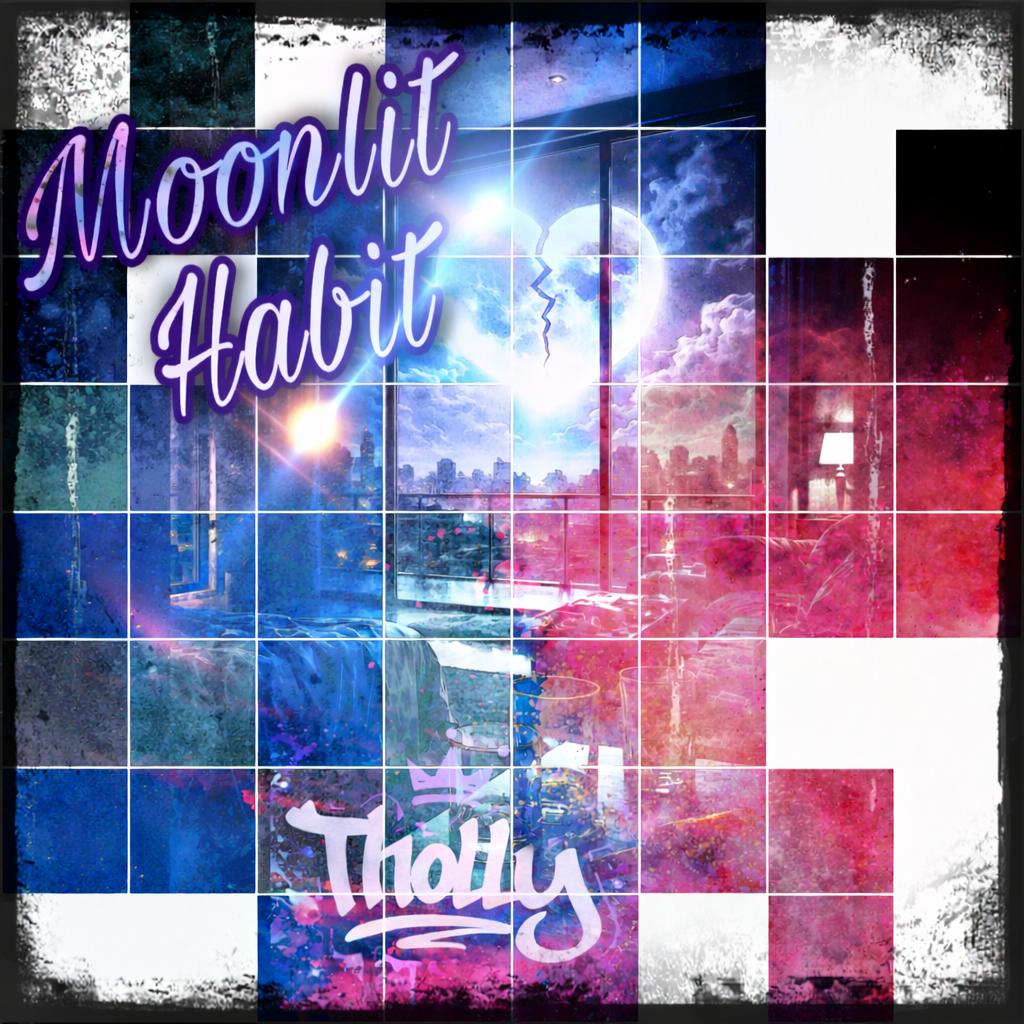
Photo: Tholly
Breaking the Cycle: Tholly on “Moonlit Habit”
In “Moonlit Habit,” Tholly turns a turbulent chapter of his life into an intimate reflection on heartbreak, fatherhood, identity, and the difficult work of breaking familiar cycles. Written after returning to his hometown, fighting for full custody of his daughter, and watching a relationship unravel, the song captures the uneasy space between an old life disappearing and a new one beginning. Rap-honed rhythmic precision meets vulnerable melody as Tholly examines the habits people return to when temporary relief feels easier than healing. Yet the record is not simply about loss or escape. It also documents growing self-awareness, renewed creative confidence, and the transformation of a painful space into a studio. In this candid conversation, Tholly discusses the experiences behind the track, the responsibility that reshaped his outlook, the production choices that mirror an internal tug-of-war, and why his next chapter will be written from the scar, not only the wound.
“Moonlit Habit” suggests something comforting, secretive, and potentially difficult to break. What does the title mean to you, and how does that idea unfold throughout the song?
To me, “Moonlit Habit” is about the things we fall back into when nobody’s watching. There’s something comforting about the moonlight because it can hide the messiness of what you’re going through, but that comfort can become a cycle.
The “habit” isn’t necessarily one specific thing. It can be a person, a relationship, a substance, a memory, or any way we escape instead of dealing with what’s underneath it. Throughout the song, that idea becomes this feeling of being stuck on replay. You know something isn’t good for you, you know how the story ends, but there’s still a strange comfort in returning to what’s familiar.
That’s really what the song is about for me: the difference between healing and escaping. Sometimes the things that make the night easier are the same things keeping you from moving forward. Eventually, you have to stop replaying the same patterns and actually face what you’ve been trying not to feel.
The track was created while heartbreak, fatherhood, and a return to your hometown were all reshaping your life. At what point did you realise those experiences belonged in the same song?
I don’t think there was one exact moment where I consciously decided, “these things all belong in the same song.” They were already tangled together in my life, so when I started writing, they naturally came out that way.
I had moved back to my hometown and was fighting to get full custody of my daughter, while at the same time a relationship I thought was going to be part of this new chapter was falling apart. I was trying to rebuild my life while also grieving what I thought that life was going to look like.
Eventually I realized they weren’t really separate experiences. Heartbreak, fatherhood, coming home, and trying to become a better version of myself were all forcing me to confront the same question: am I actually moving forward, or am I just finding new ways to repeat old patterns?
That realization became a big part of Moonlit Habit. It’s not just a breakup song to me. It’s about that strange period where your old life is disappearing, your new life hasn’t fully formed yet, and you’re trying to figure out who you are somewhere in between.
You’ve said the song is partly about missing the person you were before the relationship. Which parts of yourself were you trying to recover?
A big part of it was trying to recover my confidence and independence. Before that relationship, I felt like I knew who I was and where I was going. Somewhere along the way, I started measuring too much of myself through the relationship and lost pieces of the person I had worked really hard to become.
I was trying to get back the version of myself that was creative, driven, spontaneous, and comfortable being alone. The guy who made music because he needed to make it, who had big ideas and actually chased them, and who didn’t need someone else’s approval to feel like he was headed in the right direction.
But I also realized I couldn’t completely go back, and I don’t think I’d want to. Becoming a father and everything I went through changed me. So Moonlit Habit became less about finding the old me and more about taking the best parts of who I used to be and bringing them into who I was becoming.
The record explores the ways people seek temporary relief instead of addressing their pain. How did you write about unhealthy coping mechanisms honestly without romanticising them?
I think the key was writing from the aftermath instead of glorifying the moment. I wasn’t trying to make those coping mechanisms sound exciting or rebellious. I wanted to be honest about why we reach for them in the first place. Sometimes you just want something that makes you not have to feel everything for a few hours.
That’s really where the idea of Moonlit Habit comes from. There can be something comforting about escaping into the night, distractions, another person, whatever gives you temporary relief. But the song keeps coming back to the fact that temporary relief isn’t the same thing as healing. Eventually the night ends, and whatever you were avoiding is still sitting there waiting for you.
I’ve learned that if I’m going to write honestly about the darker parts of my life, I can’t just show the escape. I have to show the cost of it too. That’s what keeps it from becoming a celebration of self-destruction.
Was there a particular lyric that was especially difficult to write or record—and has its meaning changed now that you have some distance from that period?
Yeah, the line “Moonlit habits got me stuck on replay” probably carries the most weight for me. When I wrote it, I was still close enough to everything that “replay” felt very literal. It was that feeling of knowing certain choices and patterns weren’t helping me, but continuing to circle back to them because they were familiar and gave me some temporary relief.
What made it difficult wasn’t necessarily saying it, but admitting that I could see the pattern while I was still participating in it. There’s a different kind of honesty in realizing you can’t blame everything on heartbreak or on somebody else. At some point you have to recognize the part you’re playing in keeping yourself stuck.
Now that I have some distance from it, that line means something different. I hear less defeat in it and more self-awareness. Recognizing that you’re stuck on replay is really the first step toward finally changing the song.
How did your responsibilities as a father influence the way you understood healing, accountability, and the need to break destructive cycles?
Fatherhood changed the stakes completely. When it was just me, I could convince myself that certain choices only affected me. But when you’re responsible for your daughter, you start looking at your life differently. You realize that what you tolerate, repeat, and avoid doesn’t stop with you.
Getting full custody while everything else in my life was changing forced me to think about healing as more than just feeling better. It became about becoming dependable, being present, and creating stability even when I didn’t feel stable inside. I couldn’t keep using pain as an excuse to repeat patterns I already knew weren’t taking me anywhere good.
It also changed how I understood accountability. Breaking a cycle doesn’t mean pretending the past didn’t happen or beating yourself up over it. It means being honest enough to recognize your patterns and deciding that some things end with you.
That became bigger than the heartbreak behind Moonlit Habit. I wasn’t only trying to rebuild myself anymore. I was trying to build a life my daughter could feel safe standing inside.
The song combines rap-influenced rhythmic precision with a vulnerable melodic performance. Which section best represents the artist you have become?
I think the sections where the melody still carries the rhythm of the way I used to rap represent me best now. I spent years primarily rapping, so even when I’m singing, I naturally think about cadence, syllable placement, internal rhyme, and how the words sit inside the beat. I don’t think that ever left me. It just evolved.
The more vulnerable melodic parts of Moonlit Habit probably represent the biggest change in me as an artist. I grew up singing, but when I started producing my own music, I leaned heavily into rap. Over the last few years, and especially recently, I’ve stopped treating singing as something I occasionally add to a record and started letting it become the center of what I do.
So the part of the song that feels most like Tholly is where those two sides meet: the precision and storytelling I learned from rap, but delivered through melody without hiding the emotion. I don’t really feel like I’m choosing between being a rapper or a singer anymore. I’m finally making music where both sides sound like the same person.

How did you use the production, vocal layering, or changes in intensity to reflect the tension between being pulled backwards and trying to move forward?
I wanted the production to feel like that internal tug-of-war. There are moments where the vocal is more intimate and exposed, and then the layers and intensity build as the emotion becomes harder to contain. That movement mirrors what was happening in my head: one part of me wanting to let go and move forward, while another part kept getting pulled back into the same memories and patterns.
The vocal layering was especially important because I wanted it to feel almost like different versions of me occupying the same space. The lead vocal is the thought I’m willing to say out loud, while the doubles, harmonies, and background vocals feel more like everything underneath it: memories, doubts, impulses, things that keep echoing after you think you’ve moved past them.
That’s also why the repetition works for the song. Certain melodies and phrases keep returning almost like a thought you can’t shut off. But as the record grows, there’s more confidence and intention in the performance. The song may be about being stuck on replay, but I wanted the production to feel like someone gradually realizing they don’t have to keep pressing play.
Your studio physically represents reclaiming a painful space. When you listen to the finished recording in that room now, what emotions or memories surface?
It’s pretty surreal because that room used to be my ex’s craft room. After the relationship ended, I turned it into my studio, so there’s a very literal transformation attached to that space. I even have a painting in there that she made that said “This is our happy place,” that i scratched out and changed it to “This Studio is MY happy place”
which means a lot more to me now than it probably would to anyone just walking into the room.
When I listen to Moonlit Habit in there now, I definitely remember the person I was when I wrote it and how uncertain everything felt. But I don’t really experience the room as a painful place anymore. I think more about what came out of that pain than the pain itself.
There’s something powerful about making music about losing yourself in the same room where I eventually started finding myself again. I didn’t erase what happened there. I just gave the space a new purpose. And in a way, that’s what I was trying to do with myself too.
Now, i’m more focused on building up the studio, adding analog gear, and I built a vocal booth into the corner. Now I’m just stoked to hear every song I make improve from the one before.
If “Moonlit Habit” captures the moment when you began recognising the cycle, what would genuinely breaking that cycle sound like in your next chapter of music?
I think breaking the cycle would sound less like trying to escape something and more like finally having somewhere I want to go.
Moonlit Habit came from recognizing patterns while I was still close enough to them to feel their pull. The next chapter is more about what happens after that realization. There’s still going to be vulnerability in my music because that’s a huge part of how I write, but I think you’ll hear more confidence, accountability, and even some humor in the way I look back at things.
Musically, I think that means bigger melodies, more energy, and records that aren’t afraid to feel good without losing the honesty underneath them. I don’t want to spend the rest of my career writing from the wound. I want to write from the scar too, from the perspective of someone who remembers exactly what happened but isn’t living there anymore.
If Moonlit Habit is being stuck on replay, the next chapter is realizing I’m the one who gets to choose what plays next.
Be on the lookout for a single called “nothing left to say”, it is from a completely different perspective!
http://scratch-ent.com
http://www.soundcloud.com/itstholly
http://www.youtube.com/@itstholly
https://www.instagram.com/itstholly
FVMusicBlog August 2026
If you would like to submit your music for a playlist or review consideration, please submit here.
Also! Check out the awesome other artists on the ‘Discovered This Week’ Playlist!


Leave a Reply