
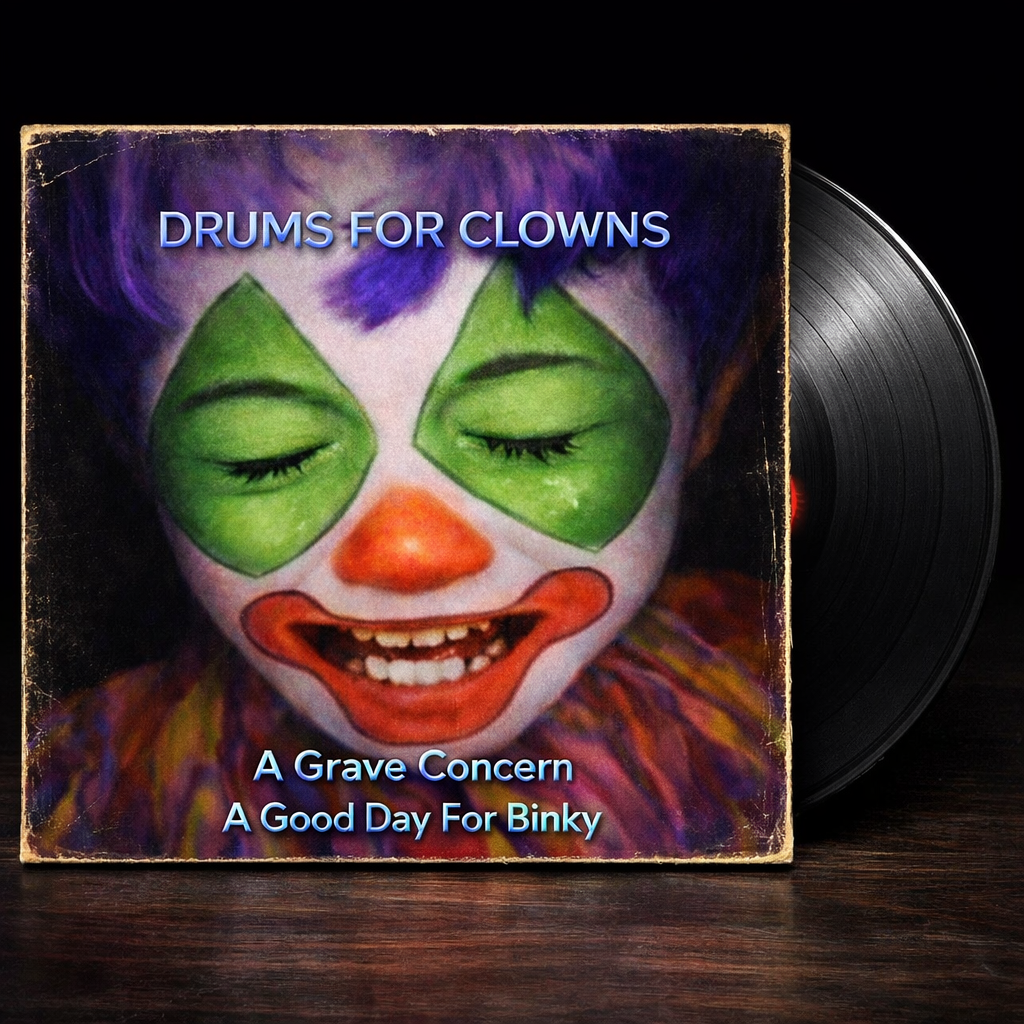
Photo: Grave Concern/A Good day for Binky
Drums for Clowns Revisit the Darkness and Survival Behind “Grave Concern”
More than two decades after its original release, Drums for Clowns return to “Grave Concern,” a song shaped by anger, grief, obsession and the struggle to survive. First formed during Kit’s childhood and released in 2003, the track has remained intensely personal, carrying memories and emotions that have never loosened their grip.
Its 2026 revival preserves that rawness while opening the song to listeners who may be encountering the band for the first time. Accompanied by a cinematic official video featuring Kit’s son, Cobain Cooper, the new release explores the connection between childhood, mental illness, family and endurance.
Familiar riverbanks, railway lines and open landscapes give visual form to thoughts that words and music cannot fully express. In this interview, Kit reflects candidly on the song’s origins, the promoter who first championed it, the experiences behind its unsettling sound and what “Grave Concern” means to him today, all these years.
“Grave Concern” has been described as frenetic, angry, obsessive and depressive. What was happening emotionally when you originally wrote the song?
I was all of the things you’ve described at the time—and probably still am now. I’ve carried this song with me since I was a young boy: the hurt, the anger, the lightning.
Kit, you’ve said that some songs are written because they refuse to leave you alone. What was it about “Grave Concern” that demanded to be written?
It’s just in you, I guess. If you ask any artist why, the answer is usually, “I don’t know—I just did it.” It’s that burning nervousness you can’t describe, even when you have nothing to be nervous about.
The song explores loss, grief and mental health. More than two decades later, has your understanding of those themes—and the meaning of the song—changed?
Very much so. I don’t want to die anymore, so I guess I’ve come to grips with my illness. Actually, living longer helps with these thoughts. I’ve learned to embrace who I am: the mania, the sadness and the days when you feel as though you’re the only person on Earth who feels these things. I lived through it to recreate, but not duplicate—there’s only one you!
The song’s meaning never changes. It was who I was then, and it’s who I am now. Only the world around you changes.
Why did 2026 feel like the right time to revisit “Grave Concern” and introduce it to a new generation?
There was a promoter who championed us way back then called Michael Thompson. He was a top man who believed in us, and his was the first review the song ever received. It blew him away, and it also blew me away to think that someone actually related to my thoughts and my music. I couldn’t scratch that itch—the thought that I might be able to affect someone else in the same way.

When returning to a song first released in 2003, how did you preserve its original intensity while presenting it in a way that feels relevant today?
2003 seems like yesterday. The song was originally formed when I was 12, so the intensity has never left. Every word, sentence and chord resonates with me personally, and they take me to different places. I can still smell it.
Drums for Clowns are known for transforming difficult experiences into powerful music. How do the song’s urgent instrumentation and haunting melodies reflect the emotions within its lyrics?
The tune and direction of the song were always driven by how I was feeling at the time. I wrote a song called “8% Happy” a while back, which generally reflects the mood of most of my music. I genuinely don’t think it’s in me to write a happy song—which I find sad.
Cobain Cooper plays a central role in the new official video. What inspired you to bring him into the story, and what does his presence represent?
Cobain is my son—a product of my survival on Earth, along with my daughters, Ribbon and Eden. You just have to stick around to see them. Cobain was the perfect character: an image of me when I was a child. He represents survival and everything I thought I was as a human being. He got free of the rails.

The video contrasts the song’s darkness with Cobain’s innocence and understated performance. What did that contrast allow you to communicate that the song alone could not?
Sometimes words aren’t enough. As a songwriter, even though you sell records or achieve fame, and everybody says that “they get it,” you never truly feel that they do. So, to visualise it—even just a little—helps the process, I guess.
Railways, open landscapes and moments of solitude create the video’s cinematic world. How were these images chosen, and what significance do they hold within the story?
They are the riverbanks I grew up on. The calmness of a river never reveals what lies underneath—or the growing urge to find out.
For longtime fans who remember “Grave Concern” from 2003—and listeners encountering it for the first time—what do you hope they take away from the song today?
The same thing they did 20 years ago. You either connect with it or you don’t. I happen to really like Marmite; some people don’t. Music is always a personal choice and can’t be forced upon anyone. Take it or leave it!
https://x.com/CooperKit
https://youtube.com/channel/UCPk8Kx14pzjhnzyh71lhMBw?si=6A3w3G8LG-tr4NI8
https://www.instagram.com/kitcooper13
FVMusicBlog September 2026
If you would like to submit your music for a playlist or review consideration, please submit here.
Also! Check out the awesome other artists on the ‘Discovered This Week’ Playlist!


Leave a Reply