
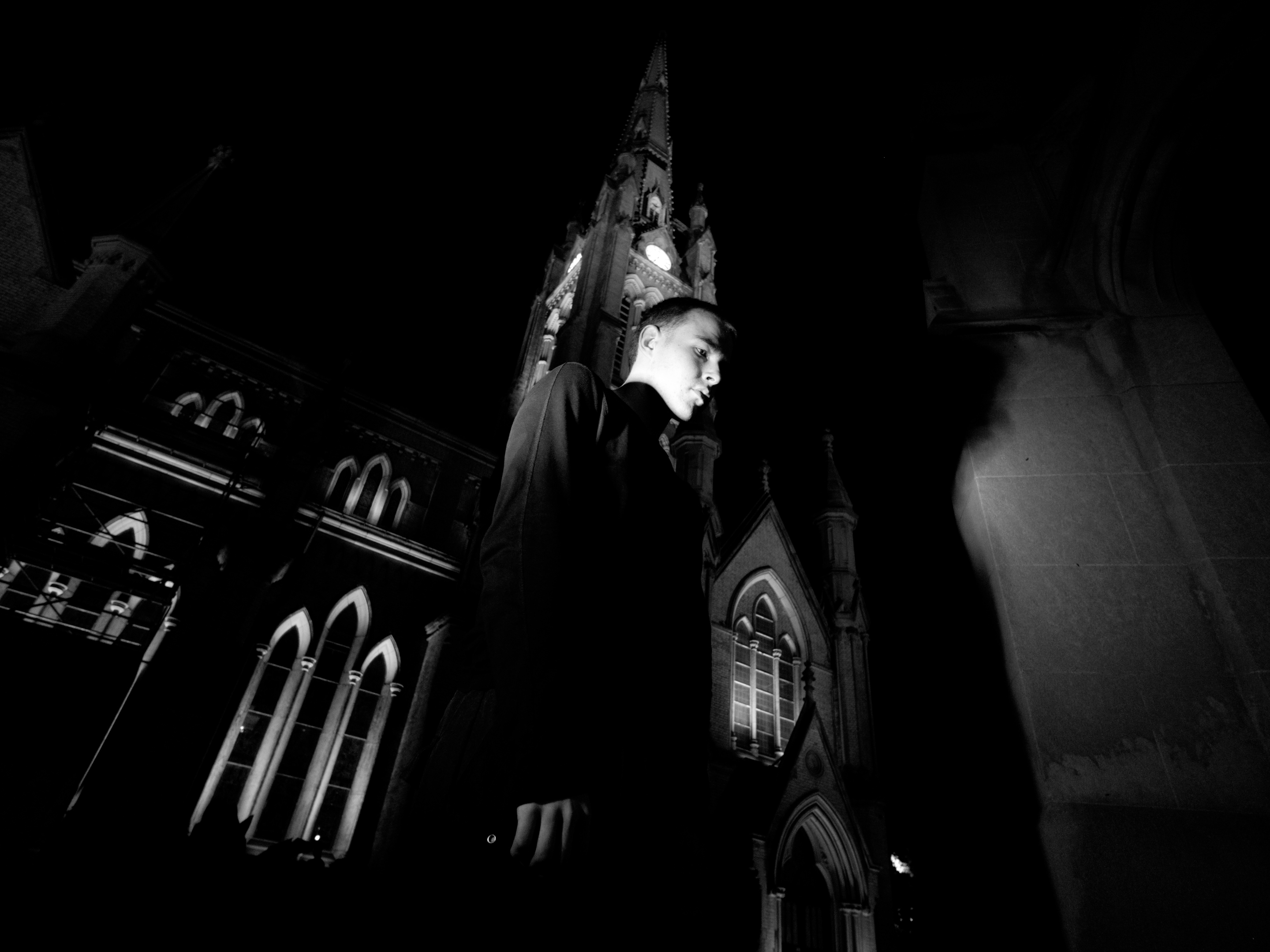
Photo: Ethan Moraux
Ethan Moraux Discusses “Icon Killer,” Creative Identity and His Experimental Sound
Toronto artist Ethan Moraux is pushing at the boundaries of underground rap with “Icon Killer,” an experimental single shaped by betrayal, ambition and unwavering self-belief. Released on 27th August 2026, the track pairs Moraux’s aggressive vocal delivery with Cohen’s dark, hard-hitting production, drawing together elements of rage rap, digicore, hyperpop and glitchy electronic music.
It also marks Moraux’s first professional studio recording, captured at Diesel Headquarters before being mixed and mastered by the artist himself. Having written his first song at six, the 20-year-old vocalist, writer, producer and engineer is now building a distinctive creative world informed by mysticism, occult history and Renaissance imagery.
Following an enthusiastic response at live performances in Toronto, “Icon Killer” represents an important step forward for his developing sound. We spoke with Moraux about the experience behind the song, his collaborative process, musical influences, visual identity and the ambitions driving his rapidly evolving project.
“Icon Killer” was created in response to betrayal by a former collaborator. How did you transform the anger surrounding that experience into a song about ambition and self-belief rather than allowing it to remain purely confrontational?
I think I’ve always been that way. I’ve been really lucky to always have a sense that music is an outlet for my emotions. While the guy I wrote the song about and I weren’t very close, it still hurt my friends and hurt me to see them still dealing with his antics. Seeing that served as a reminder to me that there are still people out there who create from a place of ill intent, even if it is an established artist, someone to look up to or… an ‘Icon’.
Hearing the beat for the first time that night, I knew I needed to get my energy about the situation off my mind and channel it into something better, something beyond me in a sense. It was seamless; I just started writing, and it all started to make sense.
What does the title “Icon Killer” mean to you, and how does it connect with the identity, message and attitude you wanted to establish through the track?
I carry a strong belief that by being an artist, especially someone like me who is chasing after bigger stages and, in turn, a bigger platform, I have the responsibility of leading by example. When I say this I don’t mean being flawless and “family friendly”, I mean being a figure that steps up for what’s right. To me specifically, this means sticking up for my friends and supporters, speaking out against corruption and misuse of power, trying to present my best self to the world, and showing people that they can do the same.
To me being an “Icon Killer” especially in the context of the song means to stand up to those with a bigger platform who misuse the power they have. It’s perfectly human to make mistakes, to say things you don’t mean, etc. But when it comes to harming others intentionally and using your platform as an artist to do the same, it becomes an issue. These themes can be heard in the lyrics throughout the track; they came from a very conscious and very honest part of myself.
This was your first time recording in a professional studio. How did working at Diesel Headquarters change your performance, and what did you discover about yourself as a vocalist during that session?
I had a great time at Diesel; I’ve been back twice more since. They have a great space and enough room for collaborative sessions. I really appreciate the space and the regular crew that can be found over there. I definitely felt a little more nervous to record in front of a room of people, but I’ve worked on minimising the anxiety I have when recording around others, getting rid of my “red light fever” Lol. I got the opportunity to record with an industry-standard mic for the first time, so it took a few tries to warm up to the difference in sound.
You mixed and mastered the release yourself. Which elements proved the most challenging to balance, and what decisions helped you preserve the track’s aggression without sacrificing clarity or detail?
I always mix and master myself; I’ve spent too much time over the years learning what I like, what works with me and what I like to hear to not be my own engineer. It’s always been something I pride myself on, and I love how much control over the end product it gives me. I don’t tend to find many issues when I record these days; I think all the refining I’ve done to my setup and my vocal chain over the years has helped with that. A lot of the aggression in this track comes from the bass and the percussion.
I always make sure I use my EQ’s in a way that boosts the right bass frequencies without muddying the track too much. My favourite EQ to use is FabFilter’s Pro-Q 4. For percussion, I use Kilohertz’s Transient Shaper; that’s all I’ll really do to an instrumental. For my vocals in particular, my sweet spot for clarity is between 3- 5 kHz. I like to use a lot of saturation on my vocals and on my master to shape the sound in the most flattering way for me.
How did your friendship with Cohen influence the creative process, and what does he understand about your artistic direction that makes your collaboration work so effectively?
I had Cohen take a look at this question and sum it up himself; he states, “Ethan’s a smart guy. Smarter than most. One thing that’s very important for me is intentional direction in music, and Ethan understands that perfectly. He gets the sound selection, the energy, and the feeling I try to replicate with my music.
I’ll never work with an artist who isn’t trying to be unique or weird with their music. Everybody needs to have their own “swag” per se, and Ethan has exactly that. I can see that we are pushing something that’s never been heard before, and that, to me, is what makes it so fun and enjoyable to work with him.”

“Icon Killer” combines rage rap with digicore, hyperpop and glitchy electronic percussion. How did you bring those different influences together while ensuring the finished track still felt unmistakably your own?
Those are all sounds that influenced me in my early teens. I used to sit in class all day with my headphones in, listening to Osquinn and the rest of Novagang. To answer your question, I’d say I’m always very careful and conscious about my sound selection, and I’m very fortunate that Cohen understands and shares some of my sonic influences.
I’m very drawn to digital melodies and off-kilter, very hard percussion. Getting to add my vocals and mix them in styles inspired by the artists who came before me is part of what has helped this track feel unique to me, while also combining my many, many influences from over the years.
You have mentioned the influence of PC music pioneers such as SOPHIE. What have you learned from that movement’s approach to sound design, experimentation and challenging conventional ideas about genre?
I think what inspires me most about SOPHIE’s approach to music was how much she cared about texture. She always had her ways of creating insanely textural percussion, sounds that could be described as metallic or rubbery. I think in every genre there’s a loose set of rules to follow, and part of what makes a sound unique is to add your own takes or personal influences onto a framework that has been previously set.
I’m very blessed to be able to work alongside a team of producers like Grolth and Cohen who focus a lot on their own sound design. Even for me, when I produce for other artists, I love to use unique drums, new patterns, off-grid percussion and my own synth and lead sounds. SOPHIE has been one of my biggest inspirations in music since I found out about her in 2021. Rest in peace; she completely changed the way a generation approaches making music, myself included.

Mysticism, occult history and Renaissance imagery all inform your visual identity. What draws you to those worlds, and how do they deepen the atmosphere or meaning of your music?
I have always loved history; since I was young, I loved to learn about the people who came before us. As a kid, I loved the history of ancient Egypt and ancient Greece, learning about the deities they worshipped and all their different purposes, their ways of life, symbolism, etc.
In my teen years, I started to use meditation a lot to cope with my emotions; I would later pair it with visualisation practices that I used to manifest certain outcomes or desires into my life.
My eyes really opened to a world of knowledge I hadn’t been taught about anywhere else in my life. I read books, I watched videos, documentaries, followed influencers, and learned as much as I could to try and explain the world around me. I read a lot of religious texts in my early teens as well, just to understand the belief systems of my religious friends. All this learning led me down the path I currently follow. There is so much to learn from all these ways of life, and all this history. I am inspired by art, symbolism and the magic that surrounds it all.
A few months back, I was very fortunate to have an online meeting with an a&r. While I was happy that efforts were catching somebody’s attention, I was told my branding needed to be more concrete and identifiable. I was at a crossroads; I had been told this before, but I never knew how to brand myself in a way that felt authentic. It was then that it clicked: I could use the symbolism that resonated with me most and build a world around my favourite concepts, lessons and history.
Audiences have described the track as “a new genre of rage” and said that it sounds “evil.” Why did those reactions feel so affirming, and what did performing the song live teach you about how listeners experience its energy?
I wouldn’t necessarily describe what I’m doing as a new genre, but I’m definitely trying to make myself distinct. And if that’s what they mean, I’m glad that’s being recognised. I definitely understand the comment about it sounding “evil” as well. It’s affirming to me because it’s what I’ve been chasing for years; to be told I sound unique is a compliment I’ve always wanted to hear about my sound. Playing this song live is a different world. I’ve been very fortunate to get lots of opportunities to play live this year.
While it’s mostly about fun, engaging with my supporters and finding new ones, I definitely use it to test songs and see what crowds respond best to. I try my best to give it my all whenever I’m on stage; it’s what the crowd deserves after paying to see me. A high-performance energy, paired with a high-energy, “evil” sounding song, seems like the perfect storm that has made crowds react to the track in the way they have.
In early August I played it live to a sold out show and a crowd of 150, it was insane to me to have a crowd of that many people react so positively to my music, hands down one of my favourite summer memories and something I’ll be motivated to chase after experiencing again.
You began writing songs at six and now describe music as something you feel destined to pursue. At this early stage of the Ethan Moraux project, what kind of artist are you working towards becoming, and where do you hope “Icon Killer” will lead you next?
I want to achieve the dream I’ve had since I was six. I want to be on stage every night; I want to inspire the people around me; I want to show others that they can do anything they put their mind to. I want to make music for people to go insane to; I can’t wait to see a crowd mosh to my music. In terms of the project, I wouldn’t have been able to answer that question in the spring; I was really confused about what I wanted to do and who I wanted to be. It became clear to me what direction I wanted to take sonically after the release of ‘Sacrificial Lambs’, and the rest of the music that has followed is slowly building up to the release of my debut EP on October 8th.
https://soundcloud.com/ethanmoraux
https://www.youtube.com/@ethanmoraux
https://www.instagram.com/ethanmoraux
FVMusicBlog September 2026
If you would like to submit your music for a playlist or review consideration, please submit here.
Also! Check out the awesome other artists on the ‘Discovered This Week’ Playlist!

Leave a Reply