
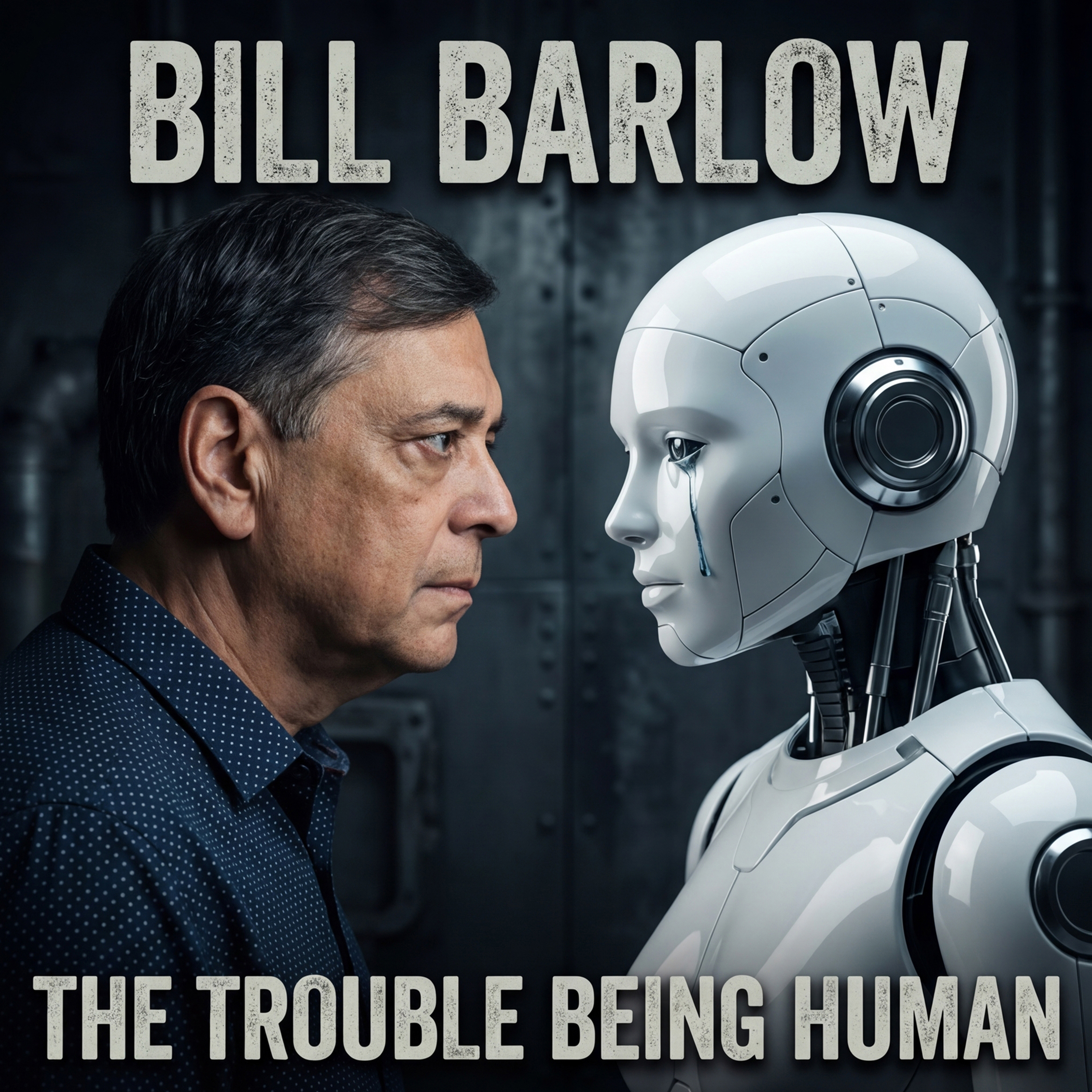
Photo: Bill Barlow on The Trouble Being Human
Bill Barlow on The Trouble Being Human
In a time where artificial intelligence is rapidly reshaping creativity, identity, and the way music is made, Bill Barlow returns with a bold and thought-provoking new album, The Trouble Being Human. Spanning 18 tracks, the record explores what it truly means to be human in an increasingly automated world—balancing emotion, imperfection, and authenticity against the rise of machine-made art.
Blending genres including Pop, R&B, Rock, Folk, and Blues, Barlow crafts a deeply personal and immersive listening experience. From introspective moments to lighter, escapist tracks, the album takes listeners on a carefully structured journey. In this interview, Barlow opens up about the inspiration behind the record, the realities of being an independent artist in the age of AI, and why human expression still matters now more than ever.
The Trouble Being Human explores identity in the age of AI — what was the moment or realisation that made you feel this was an album you had to make now?
AI has become an overwhelming part of recent conversations. And while AI brings us a lot of value, it brings a lot of shakeups in the process. Recently, a song made it to the top 10 of the digital charts that was 100% AI-generated. Fans clearly don’t care while the industry scrambles to preserve what it has created. Regardless of where you fall in the AI arguments, one thing that I hope to preserve is human authenticity, human passion and emotion.
The title track wrestles with the fear of being replaced by machines — how much of that comes from personal experience as an independent artist today?
My day job is advertising. I have watched agencies get stripped down to a few people, all replaced by AI-generated images, writing, and creative. Anyone who wants music for a commercial now simply generates it with AI. Why spend the time and money on a band when you can knock out the same thing in 5 minutes? As I try to transition from my advertising career to my passion as a songwriter, I fear that most of the opportunities that were available to me a couple of years ago have already started to go away. I take pride in writing my songs without computer intervention. But as I look into the near future, my competition is not other artists, it’s machines and algorithms.
You mention the tension between “artificial perfection” and human flaws — do you feel audiences are starting to value imperfection more again, or are we still chasing perfection?
I will say that there is something intangible about a well-produced but slightly flawed human performance. It feels different and evokes emotions that aren’t there in a perfectly polished or artificially perfect production. It’s the same difference in listening to a well-produced studio record vs a live performance. You may not be able to articulate it, but the live performance gives you a connection and makes you feel something in a different way.
This album blends Pop, R&B, Rock, Folk, and Blues — how intentional was that genre fluidity in expressing the album’s themes?
My lane is emotional conveyance. It’s hard for me to do that in a single genre. Moods and emotions require, at least for me, a wider breadth of styles.

Tracks like “Dream Girl” and “Chillin’ in Zanzibar” bring a lighter, more escapist feel — how important was it to balance the heavier themes with moments of relief?
I see the albums I release as a small journey. There are highs and lows. These songs help bring the listener around, setting up the next set of emotional experiences in the following tracks. I’ve always liked to have a balance of emotions, so the listener walks away with a variety of experiences.
Your previous album, Out of Obscurity, marked an emergence — in what ways does The Trouble Being Human feel like a confrontation or evolution from that point?
All progress at some point has roadblocks and detours. Sometimes it’s personal growth, other times it’s time management, and so on. I’m constantly learning new things to help myself grow as an artist. I feel that part of my journey is going well. I think my songs are improving, and hopefully that is being translated into the work. That’s the evolution. The confrontation comes in struggling to be heard, being compared to or even judged by, AI and algorithms. That is a struggle that most independent artists face on a constant basis.
Your music deserves more than $0.004 per stream… Get our FREE guide – instant download.
As a digital composer in an AI-driven world, how do you personally define what makes something “authentically human” in music?
That gets harder and harder as time goes on. If you think about it, synthesisers, electronic drum machines and even electric organs with “voices” are no longer authentic by literalist standards. These are all sampled or manufactured sounds coming from a chip. Maybe they were played at one time by a human, and maybe they weren’t. Then, with digital sound processing, filters and plugins in post-production, even a string instrument played live can sound completely different.
Keep in mind that all of that is used by me and by most recording artists out there. AI-generated music is just a little bit more automated but employs all of the same tools. So, I guess to define “authentically human”, a song must be human-written, performed live and devoid of any electronic processing or instruments.
The album spans 18 tracks, which is a substantial body of work — did the length come from having a lot to say, or from wanting to fully immerse the listener in this world?
Some of both. I have a lot of material that I have been holding on to for many years. I’ve been updating it lyrically and finding the right emotional feeling for the music. I had a hard time narrowing down the tracks to 18.
The closing track is a live studio session — what made you end the album in such a raw, stripped-back way?
“Truth in a Bottle” stylistically doesn’t match the rest of the tracks. I wanted to include it as a flipside to The Trouble Being Human in a way. Call it the punctuation at the end of this sentence. It’s as human as it gets, and the least produced. I wanted to end the album on something that truly felt authentic.

If a listener only takes one message away from The Trouble Being Human, what do you hope stays with them after the final track ends?
Even in a world where machines can imitate almost everything—from our voices to our choices—they can’t replace the lived-in, imperfect, messy, emotional experiences of being human. Hopefully, at least one track resonates with the listener in this way.
https://www.facebook.com/BillBBarlow
https://soundcloud.com/famousdiscoveries
https://www.youtube.com/@BillBarlow/
https://www.instagram.com/billbarlowmusic/
https://t.me/BillBarlowMusic
https://www.tiktok.com/@billbarlowmusic
FVMusicBlog April 2026
If you would like to submit your music for a playlist or review consideration, please submit here.
Also! Check out the awesome other artists on the ‘Discovered This Week’ Playlist!

Leave a Reply