
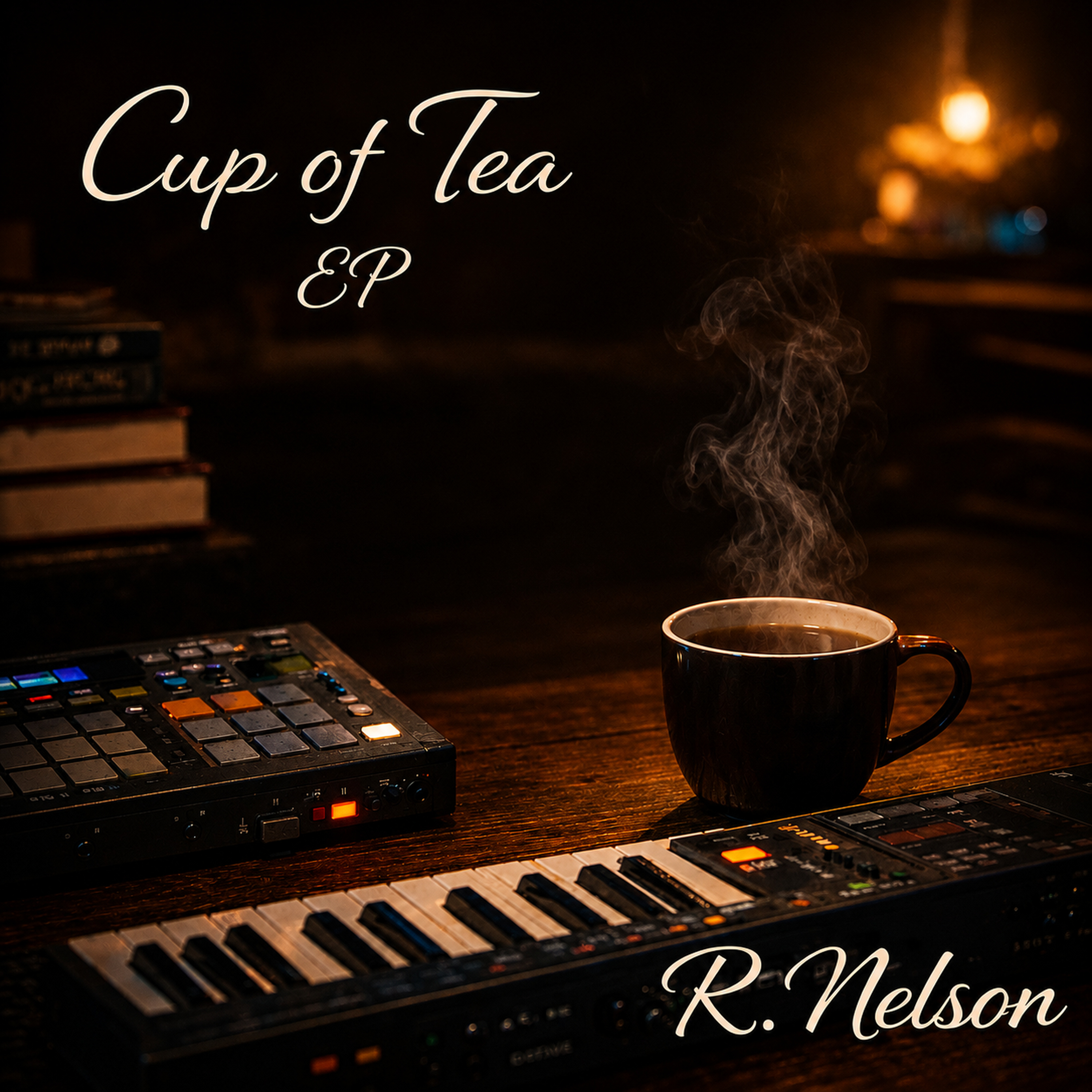
Photo: R.Nelson
Interview: R. Nelson Bridges Two Creative Worlds on Cup Of Tea
Washington, D.C. artist, songwriter and producer R. Nelson returns with Cup Of Tea, a six-track R&B and soul EP that expands one album cut into a wider conversation. Originally featured on Songs and Music by R. Nelson, Vol. 1: Grown Man Energy, the song is revisited through alternate interpretations, an early draft, a female response and a relationship narrative.
The project also connects R. Nelson with his Geese Da Goon identity through “I Didn’t Change, I Expanded,” featuring sides of his artistry within one release. In this in-depth interview, Nelson explains how those contrasting identities express different parts of his personality, why Cup Of Tea continued evolving after the album was complete and how AI supports his production process.
He also discusses overcoming gatekeeping, creating connections across his catalogue and building an independent ecosystem through Ashy Knuckle Productions, Team Mumbo Sauce, Sound Off Media and the Nelson Creative Group vision.
You have described R. Nelson and Geese Da Goon as two different sides of your creativity. When an idea first takes shape, what tells you which artist it belongs to, and have you ever started creating a song for one identity before realising it needed to become part of the other’s world?
Yeah, you came out swinging with this one, didn’t you, Kris? (Laughs.) I’m gonna have to bring my “A” game for this interview. I’m glad I ate my Wheaties.
Honestly, I have pretty defined lines between what is an R. Nelson record and what is a Geese Da Goon record.
R. Nelson is smooth, silky, a little more polite and refined. Geese is aggressive, brash, in-your-face, sometimes offensive, but always clever about it. So when I’m writing, I usually know exactly who I’m writing for.
But there are definitely times when I’ll write something with one artist in mind, read it back, and think, “Hmm…this actually fits the other one better.” Or sometimes I realise, “This could work for either one, but it would really shock people if I released it under this identity.”
I’ve got several songs like that.
“Morning Sunrise” is probably one of the best examples. That’s a Geese Da Goon record, but sonically and emotionally, it could very easily live in R. Nelson’s world. And that’s part of the fun for me. Every now and then, I like letting one side step across the line just enough to remind people that both artists are still coming from the same creative mind.
R. Nelson’s music often embraces vulnerability, reflection and mature soul, while Geese Da Goon grew from your connection to roller-skating culture and a more confrontational experience with gatekeeping. What does each identity allow you to express that the other cannot, and where do you feel their personalities overlap?
Geese is the part of me that’s truly unedited. That’s where the confrontation comes from. That’s where the aggression comes from. If something needs to be said without dressing it up too much, that’s usually Geese.
R. Nelson isn’t really designed that way.
But R. Nelson has what Geese sometimes lacks: refinement, class, patience, and a more measured way of thinking things through.
Let me put it another way. I’m guessing you’re a Marvel fan and you’ve seen the movies. Think about Bruce Banner and the Hulk. Green is my favorite color, by the way. (Laughs.)
Bruce Banner’s anger is represented by the Hulk, but Hulk’s intellect, control and reasoning are represented by Bruce Banner.
That’s kind of how I look at R. Nelson and Geese.
Now, I’m not about to run around growling “Geese smash!” and tearing up roller rinks, although Geese has definitely destroyed a few skate DJs’ egos this year. (Laughs.)
But that’s the dynamic.
Geese can say what R. Nelson probably wouldn’t say. R. Nelson can express things with a level of thoughtfulness and refinement that Geese normally wouldn’t use.
Where they overlap is that they’re both still me. The honesty is the same. The observations are the same. The sense of humour is the same. They just deliver the message differently.
And there have been moments where I’ve had to let R. Nelson loosen the tie a little bit and become more like Geese.
“I Didn’t Change, I Expanded.” brings R. Nelson and Geese Da Goon together while also appearing on Geese Da Goon’s Outside project. Why was this the right song to create a bridge between the two catalogues, and what does its title say about your development as both an artist and a person?
OH YEAH! This is the question I KNEW you were going to ask! And I’m glad it was you, because you’ve covered both R. Nelson AND Geese Da Goon.
“I Didn’t Change, I Expanded” is actually one of those songs where I loosened the tie and let R. Nelson cut loose a little bit.
And yes, it was a DIRECT response.
For years, I was making music with roller skating in mind, and certain DJs just wouldn’t play it. I have a very strong aversion to house music. Saying I don’t like it is probably an understatement. (Laughs.) In the American roller-skating community, especially with some DJs and skaters from the New York/New Jersey area, house music has become a major part of what they play. My frustration was that some would claim to play for everybody while continuing to push a sound that everybody didn’t necessarily want.
Being from DC, my attitude was basically, “Nah, I’m not rockin’ with that.”
So I started making music for the rinks because I wanted to give them something different to play. But eventually I felt like certain DJs were allowing their personal opinions of me to determine whether they would play the music. It felt like they were basically giving me the middle finger.
Somewhere along the way I became known as “the angry guy who hates house music.” And you know what? I’m cool with that. At least I stand by what I said and how I feel. I even caused a little ruckus because I made T-shirts that say “F House Music.” (Laughs.)
There’s actually a hidden feature in the song that connects directly back to that history.
The first Geese verse references song titles from Unapologetic, which is a Bandcamp-exclusive project. And the irony is that Unapologetic was basically my anti-house-music house album. (Laughs.)
So Geese isn’t just showing up on “I Didn’t Change, I Expanded.” He’s bringing pieces of his own catalogue and history into the record with him.
That was intentional, because the whole point of the song is that I didn’t erase the old Geese. I carried that history forward. The growth is in the expansion, not in pretending the earlier chapters never happened.
But here’s where everything changed.
I think some people assumed my music would always stay inside the skating rinks, where they could decide whether it got heard or not. Then I really started writing songs with lyrics, stories and meaning behind them. I played some of that music for my big brother, Da Blacksheep, and he told me something incredibly simple:
“The world is bigger than the skating rink.”
I took that advice and RAN with it.
I moved the music outside of the rinks and started putting it in front of people who didn’t know me from a can of paint. And the reaction completely caught me off guard. People actually liked it!
They didn’t know my history. They didn’t know about whatever disagreements I’d had with DJs. They didn’t have a preconceived opinion of Geese Da Goon or R. Nelson. They only cared about one thing: the music.
And I also wanted the song to show growth in my mindset. Again, skating was a space they controlled, and I eventually realised I wasn’t going to grow there as long as I allowed people in that space to have some say over how far I could go.
But time happens. Life happens. Growth happens.
I told a few of them directly, “2026 Geese isn’t 2012 Geese.”
Some dismissed it. A few threw insults, and that was cool too, because eventually some of them found out exactly what I meant.
I actually made a song addressing one of those people, and strangely enough, that record is now charting respectably in an entirely different musical ecosystem from the skating rinks. And I make it a point to tell him how that song is doing, just to be funny…lol.
There’s a certain irony in that. The person the song addresses still has influence inside that room, while the song itself has travelled somewhere that room has absolutely no control over. (Laughs.)
That’s what I meant when I said, “2026 Geese isn’t 2012 Geese.” My reach is different now. I don’t need to win an argument inside somebody else’s space when the music can simply leave the room.
That realisation changed everything.
So “I Didn’t Change, I Expanded” means exactly what the title says. I didn’t abandon where I came from. I didn’t suddenly become somebody else because the music started reaching beyond skating. I grew beyond the boundaries other people had gotten comfortable placing around me.
The core of Geese is still there. The attitude is still there. I still stand on what I believe. But 2026 Geese has a much bigger world to operate in than 2012 Geese ever did.
As for the skate DJs who were gatekeeping?
I pretty much told them, “You can have the rinks. I’m after the world.”
And funny enough, I actually turned THAT into a Geese lyric too. (Laughs.)
The original “Cup Of Tea” appeared within the larger narrative of Grown Man Energy, but you have now placed that single moment under a microscope and developed it into a six-track EP. What did you discover in the song—musically or emotionally—that convinced you it still had an entire conversation left to offer?
Man, this EP right here…
Grown Man Energy is my baby. And first, I really do appreciate you covering the songs leading up to it and then covering the album itself.
I look at songs almost like they’re my kids. Now, as a parent, you’re not supposed to have favourites.
But parents have favourites. (Laughs.)
Mine is “Cup Of Tea.”
Out of everything on Grown Man Energy, that’s probably the song I love the most.
When I was originally writing it, I was thinking about the same person who inspired “Gravity.” During that process, what eventually became the “Early Draft” came out first. At the time, I didn’t really like it enough to use it as the final version, but there were elements in it that I knew were worth keeping. So instead of throwing it away, I saved it as a reference.
Eventually, we got the version that appears on the album.
But even then, there was another groove I was debating over. The “Alternate Groove” version actually came pretty close to making the album itself.
Then one day, oddly enough, I was sitting there drinking a cup of tea, hibiscus with a few drops of lemon and a little honey, listening to an unmixed version of “Cup Of Tea,” and I had this thought:
“This entire song is from my point of view. What if she answered the whole thing?”
That idea opened another door.
And here’s something funny about me. Despite my outward personality, around this particular person I’m incredibly shy for some inexplicable reason. That’s probably another difference between R. Nelson and Geese Da Goon. (Laughs.)
So I started thinking, “What if she felt the same way, and I’m over here being shy for absolutely no reason?”
That eventually became “You’re My Cup Of Tea.”
A few days later, I was working on “Why Are You So Beautiful,” which is a duet, and I went back and listened to “You’re My Cup Of Tea” and then the original “Cup Of Tea.”
And I realised, “Wait a minute. These two songs are having a conversation.”
So there I was again with another cup of tea. If you haven’t figured it out yet, I really like tea. I probably need to cross the pond one day and learn how to drink it properly. (Laughs.)
I got to work, and that conversation eventually became “Perfectly Steeped (2 Cups Of Tea).”
By that point, the album was finished, the singles were out, the music was moving, interviews and reviews were happening, and I had already started preparing for Vol. 2. Hint, hint.
While going through my notes, I rediscovered the original “Early Draft” of “Cup Of Tea.”
I read it again and thought, “You know what? This is actually a really solid song as-is.”
So I ran it back, listened to it with fresh ears, and my reaction was basically, “WHOA. This rocks too!”
By then, I was already walking around my job singing “Cup of Tea.” One of my coworkers asked me if I knew another song, so I started singing the Early Draft.
They looked at me and said, “What is THAT?”
Which made me laugh, because they were asking like “Cup Of Tea” was already some established standard everybody knew. (Laughs.)
I keep a collection of my own songs that I listen to, some of which may never get released. At some point I realised I had all these different versions of “Cup Of Tea” sitting together, and I thought, “I can’t just keep all of this to myself.”
That’s really when the EP made sense.
I had already decided “Cup Of Tea” would become my post-album single, since I lost the argument with my COO about making it the pre-album single. (Laughs.)
So instead of simply putting the same song back out, I decided to open the notebook and let people hear the whole journey.
The album version is the destination, but the EP shows the roads I could have taken to get there, the conversation that grew out of it, and the ideas that kept revealing themselves after I thought the song was finished.
That’s what I discovered about “Cup Of Tea.”
It wasn’t really one song.
It was a whole conversation that just happened to start with one cup.
Although after making an entire EP about it, maybe I should just ask her out for a cup of tea. (Laughs.)
Rather than presenting six conventional remixes, the EP explores alternate arrangements, an early draft, a female response and an extension of the original relationship concept. How did you decide which perspectives deserved their own track, and what boundaries did you establish to ensure every interpretation added something meaningful rather than simply repeating the central idea?
I think the biggest thing for me was making sure every version had a reason to exist.
I didn’t want to make five versions of “Cup of Tea” where the only difference was, “This one has different drums,” or, “This one has a different bassline.” If I was going to build an EP around one song, each version had to show people something they didn’t already know.
The Alternate Groove comes right after the album version because that one shows the closest road I could have taken. That version came very close to being the version on Grown Man Energy, so it isn’t just some remix I made afterwards. It’s basically the alternate timeline sitting right beside the final decision. (Laughs.)
Then the Early Draft takes you even further back. That one shows where the song started before I refined it into what eventually made the album. There are ideas in there that didn’t survive into the final version, but they still show how the song was developing and what I was originally reaching for.
Then “You’re My Cup Of Tea” changes the point of view completely. The original is me saying how I feel. That song asks, “Okay, but what if she answered?” Once I had that idea, it couldn’t just be another verse of the original. It needed its own voice.
And “Perfectly Steeped (2 Cups Of Tea)” moves the concept again because now it isn’t one person talking and then the other person answering separately. Now they’re actually in the same space. It turns two perspectives into a shared conversation.
So my boundary was pretty simple: if a version didn’t reveal a new stage of the process, a new point of view, or a new piece of the relationship, it didn’t need to be there.
I didn’t want redundancy. I wanted progression.
That’s probably the best way to describe the EP. You start with the song as people know it, then move into the version that almost became the final one, then back to where the idea began, and from there the relationship itself starts opening up into different perspectives.
By the end, you realise the project isn’t really five versions of one song.
It’s five different angles on the same feeling.
“You’re My Cup Of Tea” turns the original song’s one-sided perspective into an answer. How did writing from the responding woman’s point of view affect your understanding of the original narrator, and did it challenge any assumptions embedded in the first version of the story?
Honestly? I didn’t think about it nearly that deeply when I wrote it. (Laughs.)
I basically listened to the album version of “Cup of Tea,” took what I was saying from the man’s point of view, and answered it from hers.
But the important part is that it was still a “what if.”
I wasn’t saying, “This is how she actually feels.” I have no idea! (Laughs.) The whole exercise was, “What if she answered the song? What could that conversation sound like?”
So if he says this, what might she say back?
If he feels this way about her, what if she’s sitting there thinking some of the same things about him?
I basically answered everything from the album version and let it rock.
And that actually made the original concept more interesting to me, because the first song only gives you his perspective. He’s attracted to her, he’s thinking all these things, but that doesn’t automatically tell us anything about what’s happening on the other side.
“You’re My Cup Of Tea” lets me imagine the other side without pretending that I know it.
And considering I already admitted that I’m incredibly shy around the person who inspired the original, the entire song might just be me creating the conversation I’m too shy to actually have. (Laughs.)
Which brings us right back to my problem from the last question: I’ve apparently found it easier to write an entire EP based around “what if?” than to simply ask this woman out for a cup of tea.
So no, I haven’t learned anything. (Laughs.)
You have disclosed that some AI was used in the vocals, mixing and mastering of the EP. Can you explain how it contributed to each of those areas, which creative decisions remained entirely yours, and how you ensure the technology supports rather than overshadows the human emotion at the heart of the music?
Good question, because I’m seeing the AI-in-music conversation coming up a LOT lately.
But AI in music has actually been around in different forms for quite some time.
For me, the rule is simple: AI is a tool, not the answer.
That’s another piece of wisdom I got from my big brother, Da Blacksheep.
I was already producing music before I started using AI. I didn’t suddenly stop being a producer and hand everything over to a machine. I just added another tool to the toolbox.
My process still starts in my DAW. I’m building the music there using my plugins, VSTs and whatever instruments I have available.
And I’m VERY particular about sounds. (Laughs.)
Sometimes I’ll hear a specific instrument, texture or musical part in my head, but I simply don’t have the exact instrument I need to create it the way I’m hearing it.
So sometimes I literally have to hum the part out and use Suno to help me get closer to what I’m looking for.
And I’ll be the first person to tell you: sometimes Suno doesn’t get it either. (Laughs.)
That’s when the real work starts.
I might have my version that’s close. Suno might give me another version that’s close. Then I’ll take pieces from both and combine them until I get closer to what I originally heard in my head.
That can be a process.
The lyrics are mine as well. I write my own lyrics, and sometimes I have lyrics sitting around for songs I haven’t even used yet.
And when I’m writing, sometimes the technology I need is extremely advanced.
It’s called Microsoft Word, a thesaurus and a dictionary. (Laughs.)
Once I’m satisfied with the lyrics and the music, I may run that material through Suno to help create the vocal performance and bring the words together with the track.
Then comes the fun part.
I’ll pull the stems from the version I like, bring them back into my production environment, bounce them against my original track, and start deciding what I actually want to keep from each version.
That’s where I’m mixing, replacing things, balancing things and shaping the final record.
Some of the tools I use in that process also have AI-assisted features. For example, one of my mixing VSTs uses AI to help analyse and balance the audio.
But just because a machine says something is technically “perfect” doesn’t mean I leave it that way.
I actually like some of the imperfections humans leave in music.
Sometimes something being slightly imperfect is what makes it feel alive.
So I’ll let the technology get me close, and then I make the decisions about what stays, what changes, what gets pushed forward and what needs to breathe.
The same philosophy applies when I’m getting the final mix and master together. Technology can help with things like balance, clarity and consistency, but I’m still listening to it and deciding whether it sounds like the record I intended to make.
That’s the distinction for me.
AI can help me execute an idea. It can help me reach for a sound I don’t currently have the equipment to create. It can help with vocals, mixing and the technical side of finishing a record.
But it doesn’t decide what I’m trying to say.
It doesn’t decide what emotion the song is supposed to carry.
It doesn’t decide which lyric stays, which instrument belongs, or whether something feels right.
That part is still me.
I put a lot of myself into these songs, and sometimes that includes leaving something a little imperfect because human emotion isn’t perfectly quantised either.
So again, for me, AI is a tool.
Never the answer.
“Perfectly Steeped (Two Cups of Tea)” appears to move the concept from individual attraction towards a shared relationship. What does the tea metaphor allow you to communicate about compatibility, patience and two people learning how to meet one another emotionally?
I’m an overthinker.
Well, let me correct that. R. Nelson is an overthinker. Geese probably would’ve just asked her already. (Laughs.)
“Perfectly Steeped,” which is yet another tea-based title because apparently I’m committed to this now, is still a “what if” conversation.
The original “Cup Of Tea” is one person expressing how he feels. “You’re My Cup Of Tea” asks, “What if she answered and felt something too?”
Then “Perfectly Steeped (Two Cups of Tea)” asks the next question: “Okay, what if these two people actually sat down, talked, and discovered that they fit?”
That’s where the tea metaphor really started becoming useful.
You can have two different kinds of tea. They don’t have to taste exactly alike. They can have different ingredients, different strengths and different characteristics. But there’s still a process involved in bringing everything together.
And you can’t rush steeping.
If you don’t give it enough time, you don’t get everything that’s there. Give it too much, and you can change the whole character of it.
Relationships can be like that too. Two people don’t have to be identical to be compatible. Sometimes it’s about patience, learning each other, understanding what the other person brings, and figuring out whether those differences actually complement each other.
So “Perfectly Steeped” lets me imagine what happens after the attraction and after the response.
What if both people stop overthinking long enough to actually meet each other emotionally?
Again, I have to emphasise that this is all hypothetical. (Laughs.) I’m writing the conversation that could happen, not claiming that it did.
Although at this point, after writing “Cup Of Tea,” writing her hypothetical answer, turning the two perspectives into another song, and then explaining the psychology of tea to you…
Okay, okay.
I should probably just ask her already and see what happens. (Laughs.)
The Cup Of Tea EP connects Grown Man Energy, Geese Da Goon’s Outside and the wider Ashy Knuckle Productions catalogue. Are you consciously building a shared creative universe in which projects speak to one another, and how do you make those connections rewarding for established listeners without making new audiences feel as though they have arrived halfway through the story?
You know, for the most part, I actually try to keep R. Nelson and Geese Da Goon separated musically as much as possible.
I treat them like two different people.
By the way, Question 3 was answered entirely by Geese. (Laughs.)
But no, I never intentionally sat down and said, “I’m going to create this giant interconnected Ashy Knuckle Productions Cinematic Universe.”
The AKPCU. (Laughs.)
If anything, the connections started happening naturally because I wanted people to understand that I don’t write everything the same way.
A perfect example is that I have what I jokingly call an A&R team at my job. They mostly hear R. Nelson records. That’s the version of my writing they’re accustomed to.
One day I played one of them a Geese Da Goon record.
She listened to it and basically said, “Yeah…let me go back to R. Nelson.” (Laughs.)
And that’s exactly the point.
People who discover me through R. Nelson hear the smoother, more reflective side. People who already know Geese get to discover this completely different side of my writing.
Some people know Geese primarily for instrumentals, and lately, diss records. Then suddenly they hear R. Nelson and realise, “Wait. THIS came from the same person?”
That discovery is probably more interesting to me than deliberately building some complicated universe where somebody needs to hear seventeen previous records to understand the eighteenth one.
You don’t need homework to listen to my music.
If “Cup Of Tea” is the first R. Nelson song you ever hear, it should work as a song.
If “Mr. Excuse Man” is the first Geese Da Goon record you hear, it should work as a song.
But if you’ve been paying attention to both sides, there are connections, references and little Easter eggs that give you something extra.
And the funny thing is, sometimes the audience itself shows me just how separated these identities still are.
I mentioned earlier that my music now exists in this completely different musical ecosystem called Euro Indie. Their chart goes from somewhere around number one all the way down into the hundreds.
Recently, R. Nelson charted at #29 with “Cup Of Tea.”
At the same time, Geese Da Goon was sitting at #36 with “Mr. Excuse Man,” which, hilariously enough, is a diss record I made about one particular skate DJ. (Laughs.)
So I’m looking at this thinking, “This is crazy. I have TWO completely different records, from two completely different artist identities, in the Top 40 of the same chart.”
Then I decided to conduct a little experiment.
I made separate posts about each achievement.
Now take a wild guess which one got more attention.
Yep.
“Mr. Excuse Man.” (Laughs.)
Crazy work.
And I think that says something about perception, especially within the skate community. Some people are so accustomed to their idea of who Geese Da Goon is that the idea of R. Nelson almost doesn’t compute.
They know the outspoken guy. They know the instrumentals. They know the disagreements. They definitely know the diss records.
Meanwhile, this same person is over here writing “Cup Of Tea.”
That contrast is hilarious to me.
So maybe there is a shared universe developing, but I don’t want somebody to need a map, three prequels and a post-credit scene to enjoy it.
Each project has to stand on its own.
If you’re new, you can walk through whichever door you find first.
But if you’ve been around for a while and you recognise the connections?
You get to see the whole house.

Nelson Creative Group brings music, media and apparel together around individuality, intention and authentic expression. As R. Nelson and Geese Da Goon become more closely connected, what role do you ultimately want these two artists to play within that larger vision—and what would a fully realised NCG world look and feel like to its audience?
Now I guess I get to introduce another personality.
R.J. Nelson, founder of Nelson Creative Group, Ashy Knuckle Productions, Team Mumbo Sauce and Sound Off Media. (Laughs.)
Kris, you never cease to amaze me with your questions because a lot of them dig into things the average listener probably doesn’t know about yet.
That’s also one of the reasons you tend to get a heads-up on what’s happening with AKP and NCG.
As far as R. Nelson and Geese Da Goon are concerned, ultimately they’re Ashy Knuckle Productions artists.
That’s their musical home.
Basically, they’re signed to a label.
Their own label. (Laughs.)
But I want Ashy Knuckle Productions to eventually become much bigger than those two artists.
Once I really get it up and running, I want other producers and artists involved, including human artists and artists using hybrid AI-assisted approaches.
I’m already eyeing a few people, and I’m currently in conversations about writing and producing music for another artist.
So I’m really just getting started with that part.
Then there’s Team Mumbo Sauce.
That’s the apparel side, and funny enough, Team Mumbo Sauce actually existed before Nelson Creative Group or Ashy Knuckle Productions were even ideas.
That’s where free thought and expression can live visually.
Remember that “F House Music” shirt I mentioned earlier?
That was actually one of the earliest Team Mumbo Sauce creations. (Laughs.)
I want to relaunch that brand with the same kind of passion I’ve put into AKP.
And maybe I’ve finally built the music catalogue to the point where some of it can work while I turn my attention toward developing that side.
Because I’ve already got shirt ideas in my head that can speak just as loudly, if not louder, than some of the music coming out of AKP.
Team Mumbo Sauce is gonna start with shirts and grow from there!
And Kris, understand this: when Team Mumbo Sauce really gets running, an AKP shirt is coming your way! (Laughs.)
Then there’s Sound Off Media.
Man…
That one is a ways away. (Laughs.)
But it’s doable.
Out of everything I’m building, Sound Off Media is probably the most ambitious idea because ultimately I want radio stations.
I’m still tweaking that concept in between writing songs, producing records and everything else I’m doing, but I know what I want the philosophy behind it to be.
I want somewhere that can put independent artists beside mainstream artists based on whether the MUSIC deserves to be heard.
Because I hear independent music all the time and think, “Man, THIS is the stuff people should be hearing.”
There is so much good music being made outside the traditional system.
I want Sound Off Media to eventually become another lane for that music to reach people.
And Nelson Creative Group is the umbrella over all of it.
Ashy Knuckle Productions is music.
Team Mumbo Sauce is apparel and visual expression.
Sound Off Media is eventually the platform that helps amplify voices, including voices outside of my own company.
And NCG connects all of those pieces.
So when you ask me what a fully realised Nelson Creative Group world looks like, I don’t necessarily imagine some giant corporation where everything looks and sounds the same.
Actually, I want the opposite.
I want you to be able to hear an R. Nelson record, hear a Geese Da Goon record, discover another AKP artist, wear something from Team Mumbo Sauce, turn on Sound Off Media and hear an independent artist you’ve never heard before, and still understand what connects all of it.
Individuality.
Expression.
And giving people another lane when the existing lanes don’t necessarily make room for them.
I guess when I put it that way, there’s one idea connecting everything I’ve been talking about in this entire interview.
If somebody controls the room and there isn’t enough space for what you want to create…
Build another room.
https://www.facebook.com/share/14ctaBu79rv/?mibextid=wwXIfr
https://rnelson.bandcamp.com/track/gravity
https://youtube.com/@r.nelson81?si=UGd65wLRygdiLIzC
https://www.instagram.com/r.nelsonmusic
FVMusicBlog September 2026
If you would like to submit your music for a playlist or review consideration, please submit here.
Also! Check out the awesome other artists on the ‘Discovered This Week’ Playlist!

Leave a Reply