
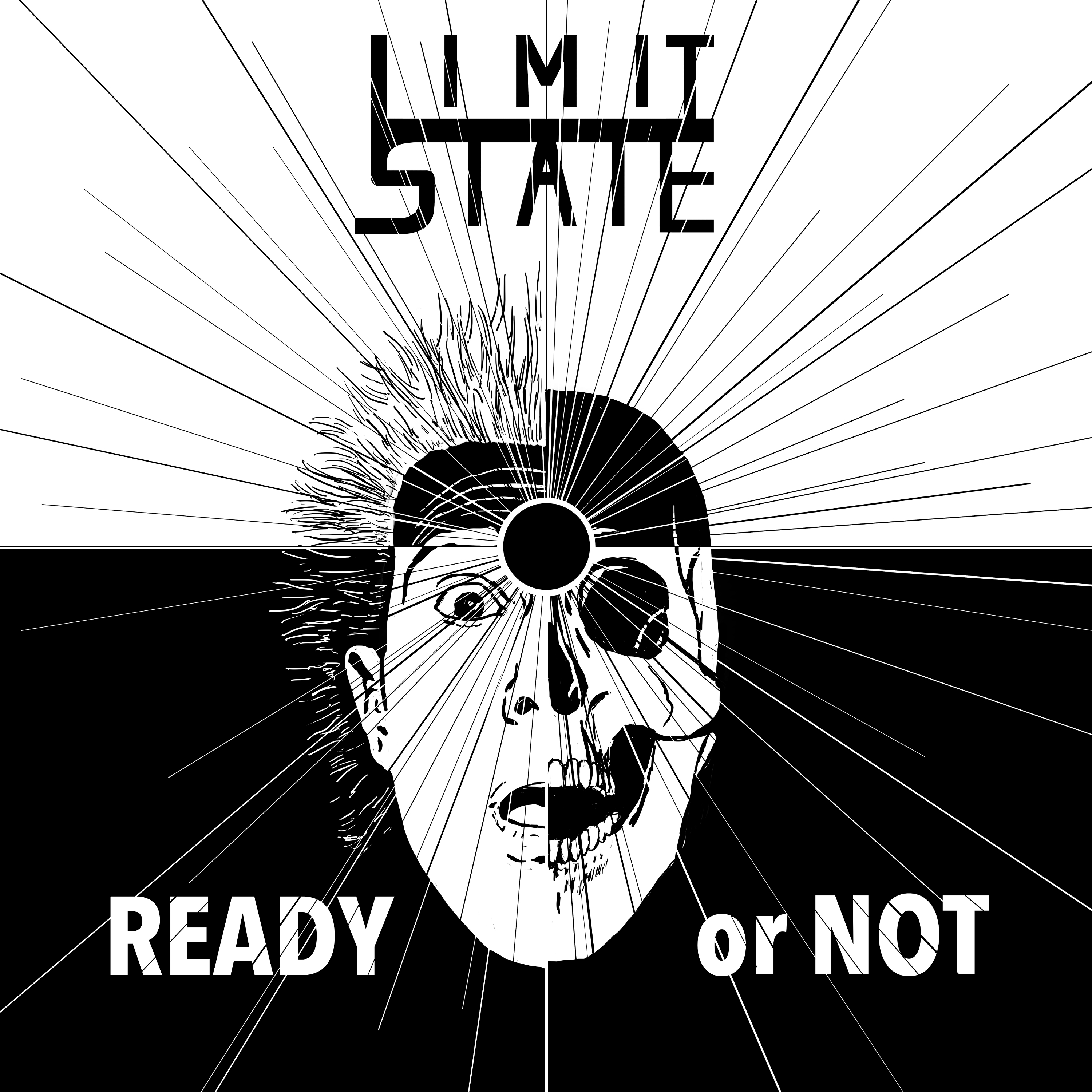
Photo: Limit State
Limit State brings together explosive guitar work, powerful vocals and a thoughtful approach to rock songwriting. Returning to the genre after almost twenty years spent exploring experimental pop and contemporary classical music, the project’s songwriter found fresh inspiration in guitarist Dave Wolfberg’s abilities and the emotional intensity of heavy blues.
‘Ready or Not’, the track that first sparked the project, pairs restrained verses with an eruption of intricate guitar patterns and sustained vocals. Its lyrics explore the uncertainty of falling deeply in love, capturing the tension between emotional possibility and the fear of getting hurt. In this interview, we explore how the song developed, the vocal training that helped bring it to life, and the creative partnership behind the album.
We also discuss the relationship between instinct and music theory, the record’s symbolic imagery, and how its wider social themes connect with intimate experiences of vulnerability, longing and reflection throughout.
“Ready or Not” was the song that set the entire Limit State project in motion. Can you take us back to the earliest version of the track and explain how it grew into the foundation for a full album?
Yeah, it was the first thing where I was like, “How do I want to use Dave’s shredding ability?” The obvious thing would be just to give him solos, and that’s what I do a lot on the album, but I also wanted to work it into the arrangement of a song in a more fundamental way. I thought, what if a tapping, or sweep-picking, gesture could be the arrangement of the chords for the chorus. Then I started writing a chord progression for a verse and chorus, with the goal to build up energy going into that chorus, so the explosive guitar gesture would make sense.
For the chorus, since the guitar is so busy, I knew the vocal would need more long sustained notes —a big scream.
Once I’ve got a chord progression, I can adapt it to fit a given genre. For Limit State, that meant turning it into a riff. To do that, I needed to use a lot of arpeggiation and kind of minimal versions of things.
And that was the first stuff I wrote for it. Lyrics didn’t come until almost a year later, when I wrote the bulk of the album in a session that was approximately 2 months. I’d been working on lyrics for the other songs, so themes were already developed and those wheels were already turning. It made them come very naturally for this song.
Limit State marks your return to full-on rock after almost 20 years working across experimental pop and contemporary classical music. What drew you back to the genre at this particular point in your life?
It was two things really, though I’ve only talked about one of them a lot. The one I’ve talked about was that I wanted to write something for Dave to shred on. I’d done two projects with him, and both required him to be more restrained in his playing. But I love when he goes all out, and I thought it would be fun to make that kind of music with him.
The second thing was that I was listening to some heavy blues music where the vocals were really wailing and hollering. I noticed how, in that music, the tension in the rhythms and harmonies makes that howling vocal feel kind of necessary and inevitable. Like, it’s not an arbitrary decision. In a lot of rock that came downstream of that, when there are wailing vocals, it doesn’t always seem as necessitated by the music. For example, if someone who wasn’t into metal heard Iron Maiden, they might ask, “Why is he singing like that?” But if they listen to Zeppelin’s first album, where that blues tension is very much present, they wouldn’t ask that. They might find it too intense for their liking, but it would make sense.
So I wanted to write some rock music where the tension in the music would make the wailing vocal feel necessary like that, without being recognisably blues or blues rock. I don’t know that this experiment really lasted through the whole album, but it definitely produced 3 or 4 tracks.
After I’d made these musical decisions, I decided what topics I’d want to sing about and just realised that hard rock would be the best way to express them anyway. So it all came together perfectly.
You initially considered hiring another vocalist before committing to an intensive period of rock vocal training. What did that process reveal about your voice, and how did discovering its heavier side influence the songs you were writing?
That’s right. Before this project, I wrote “The Stars” and got my friend Jimmie Herrod to sing it. He killed it cuz he’s amazing. People might know him from America’s Got Talent, where he got the golden buzzer and created a viral moment. He also sings with Pink Martini, has a great solo career, and does a lot of special appearance gigs with orchestras and stuff. So it was amazing to work with him. And it made me think, “Why limit my projects to what I can do with my voice?” I’m not just a singer, after all. My training is more in composition.
But when I started writing these songs, two things occurred to me. One was that it would be so fun to be able to sing them. By this point I’d accepted that when I was younger and sang rock, I never really was able to sing the way I’d hoped. The second thing that occurred to me was that now there are vocal distortion tutorials that weren’t available the last time I was singing in rock bands. At least I didn’t know of them. In fact, there’s a lot available for free on YouTube. So that’s where I went, and I actually learned everything I needed from Chris Liepe on YouTube. It was free! Big shout out to him.
Of course, it helped that I had a foundation of singing technique, classical and pop. But he gives away really great knowledge for free. If you already know how to support your voice, you can get a lot from his videos.
The verses of “Ready or Not” have a dark, grunge-influenced restraint before the track erupts into a progressive and intense chorus. How did you create that contrast while ensuring the different elements still belonged within the same song?
It was a challenge, and I figured out a little trick for it. I took inspiration from Tool. The main verse riff in Ready or Not is mostly kinda blues rock and kinda grunge. It doesn’t seem like it’s about to head to shred land. Except there are a few little gestures that throw in some faster notes. What it is technically is 16th notes, where the standard blues rock version would have stuck with mostly quarters and 8ths.
It’s a signature of Tool to insert those 16th note runs into this kind of riff rock. And it gives the feeling of a greater energy behind the music, one that could burst out more forcefully at any moment. So heading into the chorus, there’s a figure where the chords change a lot faster, and the 16th notes start flying, and that’s building up into the chorus’ explosion.
The idea for the project partly grew from your determination to write something that would fully showcase guitarist Dave Wolfberg’s abilities. What is it about the creative partnership that continues to bring you back together?
Dave is everything I want in a guitarist and a collaborator. As a guitarist, he can technically play anything I’d want, and a whole bunch of things I wouldn’t think of. He’s also a tone wizard. He knows exactly how to use his equipment to get the coolest and most beautiful sounds. Or the ugliest ones when that’s what’s called for. There’s a tone he uses in one part of the record that our drummer called “clown vomit”. And that really fits!
His creativity as a soloist is phenomenal. There are several songs where his solo elevates it to a place I didn’t imagine, and the solo becomes my favourite part of the song. One in particular is one called Pyramid (exclusive to Bandcamp, by the way, and available now). His solo at the end of that song makes the song a whole other thing. It takes it to a place I never foresaw.
As a collaborator, I can always tell he cares. He’ll push back when he thinks it needs something different. He’ll question my decisions and make sure I’ve thought it through. He’s a composer as well, so he knows what a piece of music needs, and what works and doesn’t.

Your background in composition and music theory can be heard in the counterpoint between the sustained vocals and moving guitar patterns. How consciously do you apply that knowledge when writing rock music, and when do you prefer to work purely by instinct?
Instinct and education/training are very intertwined at this point, and both are fully active when I’m writing in any genre. It’s pretty much impossible to write something intuitively and not also notice what theoretical frameworks it falls into. It’s just noticing what it has in common with other music that exists —in which patterns it participates. And the instincts on where it should go next have so much theory training built into them.
On the other hand, I’d never write something that makes theoretical sense and not care about whether the feeling is actually right.
Theory is descriptive, not prescriptive. It doesn’t give rules of what has to happen, only descriptions of the patterns that have happened. Before I had much music theory knowledge, I didn’t write in a more free way. I was just less conscious of what my patterns were and the limitations of my expressive vocabulary. Now, when I feel like a song needs something that I don’t know how to do, I have the tools to figure out what that thing would be and how I would do it.
Whether it’s rock, pop, contemporary classical, or anything else, theory has only given me more freedom, and it’s always part of how I see music.
The lyrics explore the vulnerability and frightening instability that can accompany falling deeply in love. Was it difficult to write honestly about the fear that something wonderful might also be preparing you for another emotional crash?
As an artist, you get over the fear of confession pretty fast. Finding something really vulnerable and finding an artful way to communicate it —that’s our bread and butter. The bigger fear is not having something to say, not being able to find that edge, that issue that feels really vital. You don’t want to just cobble something together that’s generic, cuz people see through that. It doesn’t impact.
You also can’t just say, “I’m nervous to fall in love cuz it feels unstable and I’m afraid I’ll get hurt. But on the other hand, life feels kind of dry and empty without it”.
That’s basically all the song is saying. But you need the right analogies, symbolic imagery, and, in this case, the right musical setting, so that people can take this plain idea and really get into the feeling and experience of it.
You have described the album’s rapid writing process as an almost mystical experience. Did you begin with a clear idea of what Limit State would be, or did its musical identity reveal itself as the songs emerged?
I began with some ideas, which account for around half, or slightly less, of what it is. In the second question, I talked about that inspiration I took from blues and from Zeppelin. Not that the music would be blues rock, but that I wanted that kind of tension in the harmonies and rhythms, which would make the rock belting & screaming feel natural and inevitable, in a way that I don’t always find it to be. Three songs on the album: The New Gods, Eat Their Young, and Pyramid (2 of which are currently available on Bandcamp) were written very much from this idea. That intention still lasted into the rest of the songs, but more in the background. I wasn’t thinking of blues as much when I wrote the rest. And Ready or Not was before that thought had even come in.
After I’d written a fair bit of music, I thought of subjects I wanted to comment on, which were large-scale societal and global issues in the world today. And I wanted to use mythic symbolic imagery, so I just started writing down a bunch of ideas for that, and then figuring out where they fit musically.
That all happened very early, and that formed the first clear identity of the band. When the album gets more personal, as it does with Ready or Not, the lyrics came from a different place, and the overall identity of the album shifted some.

The album moves from wider themes of social instability towards more personal ideas of alienation, longing and complicity. What emotional journey do you hope listeners experience as they move through the record?
First of all, I hope that I speak about things they can relate to.
When I speak on wider themes and more large-scale issues, I also tend to use more mythic and symbolic imagery. This is because I want it to be applicable to many different kinds of lives. One person will relate because of their experience working for a big corporation, another person because of their family experience, and another because of their political environment. But I think that all these areas of life are moved by undercurrents which are so broad that they’re difficult to name, except with symbolic imagery.
For example: the song Eat Their Young. If you took it literally, it’s describing a world where the old are mostly rich and the young are mostly poor, and the rich believe they can live forever by drinking the blood of the young. I am not promoting some kind of conspiracy that says this is literally true. But symbolically, many people experience many things that basically feel like this. It’s a mythic description of our age.
In the end, the idea is that the big picture and the intimate personal picture are totally interrelated. So, thematically, the album is one story. It starts with Out Loud. This is a personal song, but not with a ton of introspection. It knows there’s a problem, but not why. Then we have some songs that are about the world we’re living in, the setting for these personal challenges. These are mostly broad mythic descriptions, and they’re pretty ominous. Some self-reflection starts to come in, seeing what part I have to play in the world being the way it is, and the way that its large-scale darkness also exists in the microcosm that is me. With Ready or Not, having set this scene, with Ready or Not a new element enters. The rest of the album is the fallout.
I hope that the listener will relate, possibly even gaining some new perspective on their own experiences. The last track is an instrumental piece called Eleos. That’s also out now. Eleos is a Greek word which means “mercy” but with a connotation of healing. Ideally, I’m hoping the listener can feel some of that at the end of the journey.
One piece of merch that will be available is a lyric zine. Every track on this album has its own artwork, and this zine will have the art and lyrics for each. Speaking of merch, we have clothing available at our merch store through Fourth Wall: limit-state-shop.fourthwall.com
And you can pick up the music at limitstate.bandcamp.com
Enjoy!
https://www.limitstatemusic.com/
https://open.spotify.com/artist/0X0znwxJYUR7q2DHZJTzak?si=dcSLJxBRQDWMGujPdCfdgQ
https://limitstate.bandcamp.com/
https://www.youtube.com/channel/UCv3uH1FIAr6vXDFtD8U_Xgw
https://www.instagram.com/limitstatemusic/
FVMusicBlog October 2026
If you would like to submit your music for a playlist or review consideration, please submit here.
Also! Check out the awesome other artists on the ‘Discovered This Week’ Playlist!

Leave a Reply