
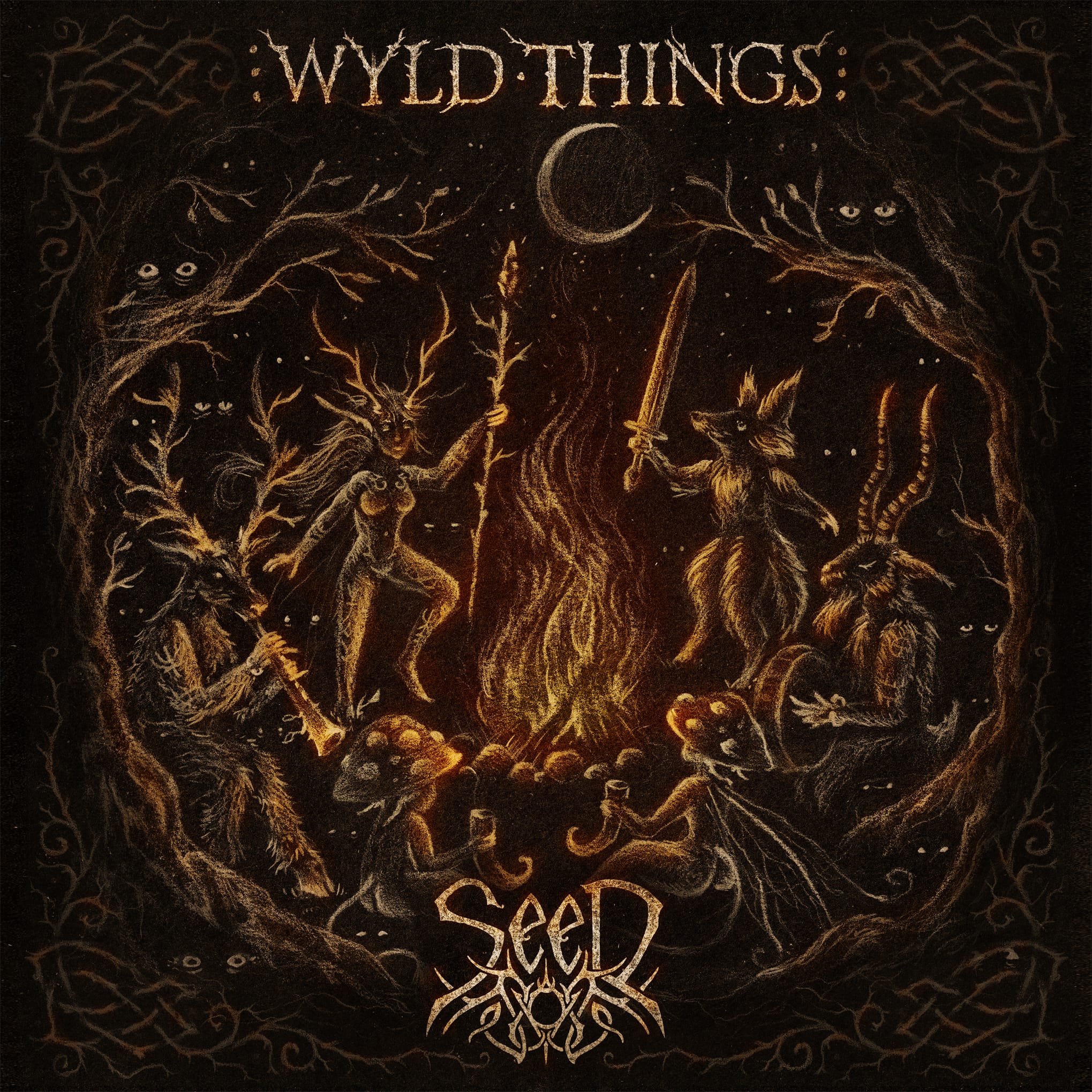
Photo: SeeD
SeeD on ‘Wyld Things’, Fantasy Worlds and the Power of Music
Blending folk music, mythology and a touch of fantasy, SeeD creates an immersive musical world that invites listeners to step away from everyday life and explore something different. Drawing inspiration from fairy tales, folklore and fantastical worlds such as The Lord of the Rings and The Dark Crystal, the band combine rich vocal harmonies with an eclectic range of acoustic instruments to create their distinctive sound.
But beneath the mystical atmosphere lies something deeply human. SeeD’s music explores emotions, personal struggles and the experiences that connect us, using storytelling and musical expression to offer listeners a different perspective on their own lives. Their approach is built around collaboration, with the band members working together to shape songs that reflect their shared creativity and individual influences.
With ‘Wyld Things’ set to become the title track of their next album, due in 2027, we spoke to SeeD about their inspiration, songwriting process, live performances and the ideas behind their latest musical chapter.
‘Wyld Things’ feels like an invitation into another world. What inspired the song, and where did the idea of the “wild things” come from?
The song was inspired by the fact that we see SeeD as something we do together with the audience. We do not just want to send music out into the world, but we want to share it and hear back from the listeners. It seemed like a good idea to make a song into a literal invitation, hence the lyrics “Will you join us”.
When people join us in the music, we do not just want to experience “nice” things with them, because life can be challenging. A lot of our songs are about “heavier” subject matter, like loss, feeling sad or being lost in your life. Wyld things seemed like an appropriate metaphor for this. Life can really feel “wyld” sometimes, and we’d like to explore this together with the audience.
Your music draws on fairy tales, mythology and fantasy worlds such as The Lord of the Rings and The Dark Crystal. What is it about these stories and imaginary worlds that continues to inspire you?
First of all, the art in these works is amazingly beautiful, so this sets our imagination ablaze. But secondly, even though these works are highly fantastical, in a way they still explore very real and relevant emotions for people in the real world. These stories just put these emotions in a world so different from ours that it sometimes makes it easier to take a step back from them and take a look at them in a new light.
A good example of real-world emotions in these works is the struggle Faramir has in The Lord of the Rings with making a choice between doing what he deems best, sending Frodo and the Ring on their way to Mordor, and disappointing his family by doing so.
The lyrics move between English and Dutch, with SeeD also using Irish in your music. What does using different languages add to the songs, and how do you decide which language fits a particular part?
Way back in the days of SeeD, we predominantly used English because most of the media we consumed was in English. Because of this overexposure to English, we found it difficult to take the Dutch language seriously, especially when it came to lyrics. It often felt either pretentious or nearly comical.
But over the years, and in no small part thanks to Einar Selvik from Wardruna fame, we came to realise that Dutch is the language in which words have the most and deepest meanings and associations for us. So we started using it more, and the more we used it, the more we could see the beauty in the language and the power someone’s mother tongue has. The same might be true for Joe with the Irish language.
We still realise, though, that English is the best language to use to make sure as many people as possible can actually understand the lyrics. So, in short, we mostly use our mother tongues when we make something powerful that can be understood without understanding the lyrics (‘De gnoom, de heks en de boom’ being an exception). And we use English when we want the world to actually understand the lyrics.
The lyrics include the lines “Get lost in a fairytale” and “Let yourself be lost / Until you recognize your way.” What do those words mean to you, and what do you hope listeners take from them?
To us, these lyrics mean taking a break from reality to recharge and find your centre. This is exactly what we hope the audience takes away from this.
We believe that people who have regular breaks from the world and its heaviness make better choices and become friendlier people. We don’t really want to tell people what to do and think; we want to support people into becoming and staying the best versions of themselves. That way, they’ll make good choices that they actually support and that weren’t made from places of anger and fear.
‘Wyld Things’ is expected to become the title track of your next album. Why does this particular song feel like the right one to represent the album?
It’s not so much representing the album as much as it’s an invitation to the rest of the album. The music on the album is going to be very varied in tempo, theming, instruments and emotions, and it’s hard to find a song that represents that.
We did think, however, that literally inviting the listener to the album while also telling them there might be some wild things inside would make for a great opener to an album. The title of the track also sounds somewhat mysterious and adventurous, which made for a good inspiration for the short intro we always want to start an album with.
This short intro was not originally part of ‘Wyld Things’, as our intros never are, but was directly inspired by it and was recorded in the same file while writing it in the studio.
SeeD uses only acoustic instruments and voices, but the music still has a very powerful and atmospheric sound. Why have you chosen to stay away from electronic instruments and production?
Well, to be completely honest, there is some electronic production on this album, as there was on our other albums. These are often subtle things, such as slight boosts to bass lines, a drone here or there and the often less subtle reverb.
We do this because our music is meant to be played acoustically in a “tavern” setting or around a campfire. That way, you get the best sound from all the instruments, and they resonate in that location, which adds a natural reverb and other effects, and you can actually look at us, which also adds a lot to the music.
But that way, only very few people actually get to hear us play, so we record the music. By doing so, though, you lose a lot of the experience. There is no group energy anymore; the sound loses a lot of natural reverb; you just have the audio and not a show to look at; and the instruments interact with each other in a lessened way.
A skilled producer adds this back in by adding effects, playing with frequencies, adding drones and other layers together with the band. This is why there most definitely is electronic production on our album, and if you want only acoustic instruments and voices, you’ll have to come find us playing an acoustic gig.
And concerning electronic instruments, we love the feel of actual sound resonating in an instrument. It’s different from sound coming from an amplifier.
There are five voices and a wide range of instruments in SeeD, from whistles and guitars to mandolin, ethnic drums and didgeridoo. How do you work together to create the band’s distinctive sound?
We mostly write songs collectively. Often, someone comes in with a concept, lyric or musical part. Then we start playing around with whatever has been brought in.
Sometimes instruments are being switched around, or being requested by the band members to try out which sounds work the best. But we’ve also been doing this for a while now, so it happens more often that we immediately know what will work with whatever is brought in.
This choice can be based on the sound of the instrument, but also on what seems the most fun or suits the playing style of the instrument best. Then band members often make requests for certain melodies or rhythms. This way, we make a first version.
This is then further polished by playing it together over time and by people working on it at home, although this is less common. During this process, we keep trying things out and making changes, usually until the song has either been played live or has been recorded.

Your music has been described as mystical, playful and cinematic. When you are writing and performing, do you see yourselves as telling a story through the music?
Sometimes we do see ourselves as telling a story through music. This is very apparent in songs like ‘Thorny Vines’. But also, a large part of what we do is trying to accompany the story of the listener.
Like with the song ‘Bloem’, we are not telling an actual story; we’d just like to be there and help someone going through a rough time and make their story a little bit more bearable.
But this can also happen in the smallest of ways, like walking past the shower section of a festival at midnight and hearing people play ‘Song of the Sea’ while showering. Or being at a pagan celebration and, on the morning after, hearing someone’s alarm go off, and it’s ‘Crazy Pagan Party Song’.
You have performed at festivals across Europe and the UK. How does playing SeeD’s music live compare with recording it, and what do you particularly enjoy about bringing this fantasy world to an audience?
Playing music live and recording music is insanely different and therefore hard to compare. There are different things to like about both, and they are both fun.
Recording is very much a calm process, as calm as SeeD members get anyway, with loads of pressure to make things as perfect as you can, because you’ll be listening to this under a magnifying glass for the rest of your life. But on the other hand, there are second chances while recording, and it’s possible to talk everything over with the other members.
Being on stage is another beast altogether. You have one chance to play a note right, and it’s gone forever. It’s high energy and fast-paced. You are making choices on the fly, and you make decisions by yourself and have to trust your band members to handle whatever you throw at them.
Even the technical aspects of playing music are different. In the studio, we play along to the metronome, while live we follow each other’s tempo and there can be fluctuations. On stage, you are concerned with whether you can see your strings because of the light show and how much the copious amount of sweat makes everything slippery.
In the studio, you are concerned with eliminating whatever weird buzzing sound apparently emanates from your instrument when being played in a completely silent room with thousands of euros’ worth of mics pointed at you.
You are currently working towards your next album in 2027. What can you tell us about where SeeD is heading next, and what can listeners expect from this new chapter?
There are no great surprises there. We still make music the same way and from the same place of inspiration. We’ve matured a little in our private lives, and this will probably be reflected in our music.
So we hope to be doing the same thing, but better. But most of all, listeners can expect music that we like to play and write, whatever that might be, for that is our main drive for actually continuing to make music and be in a band.
https://www.seedpaganfolk.nl
https://www.facebook.com/seedmusick
https://seedpaganfolk.bandcamp.com
https://www.youtube.com/c/SeeDPaganFolk
https://www.instagram.com/seedpaganfolk/
FVMusicBlog October 2026
If you would like to submit your music for a playlist or review consideration, please submit here.
Also! Check out the awesome other artists on the ‘Discovered This Week’ Playlist!

Leave a Reply