
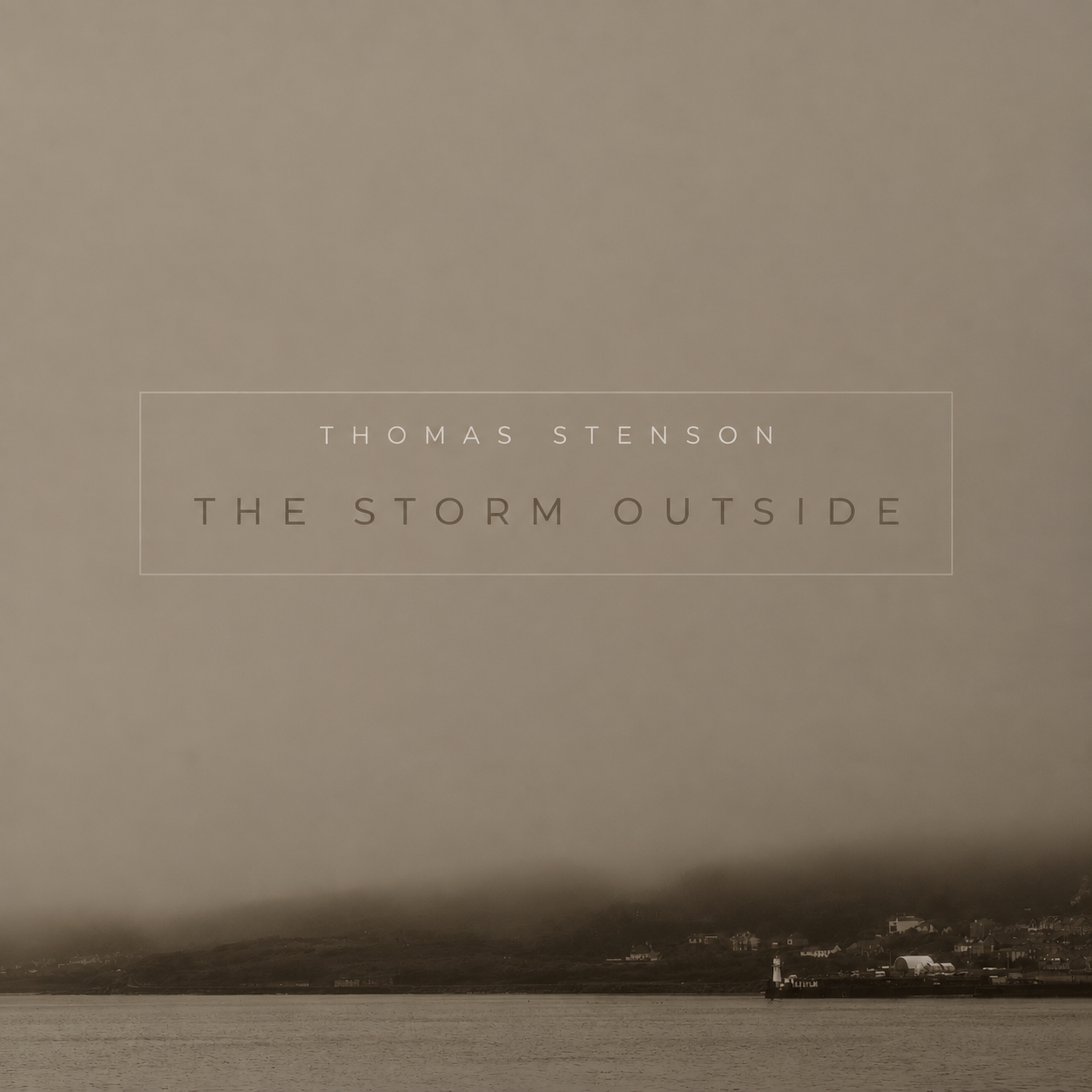
Photo: Thomas Stenson
This coverage is created via #sustainablecurator
Thomas Stenson Interview – Finding Confidence, Creative Freedom and Hope on ‘The Storm Outside’
For Birmingham-born, Coventry-based songwriter and producer Thomas Stenson, making music independently has been part of life since his teenage years. Finding the confidence to release it under his own name has been a longer journey. His forthcoming EP, ‘The Storm Outside’, arrives on 27th November 2026, following his first solo EP, ‘Brighter Days’, and renewed enthusiasm through playing guitar with Wax Laszlo. Written, recorded, produced, mixed and mastered in his home studio, the collection explores hope through songs about loneliness, change, conflict and breaking out of familiar routines.
In this interview, Stenson explains how an unsuccessful rehearsal yielded the beginnings of ‘Rain’, why he is giving guitars a different role in his arrangements, and what it takes to stop revisiting a nearly finished recording. He also reflects on returning to Erdington, finding a musical community in Coventry and finally feeling comfortable sharing work that carries his own name with listeners.
The Longer Journey Towards Releasing Solo Music
You had been writing and recording independently for years before releasing music under your own name. How did the end of Seconds Out, playing with Wax Laszlo and releasing ‘Brighter Days’ help build the confidence that led to ‘The Storm Outside’?
I’ve actually been writing and recording music on my own since I was a teenager, but for a long time I was quite scared of releasing anything under my own name. Being in a band always felt like a more comfortable way of sharing my songs. With Seconds Out, for example, I wrote a lot of the material and brought it to the rest of the band, but there was something reassuring about making music together, and sharing the cost of recording in local studios made things easier too.
Seconds Out released two EPs and played gigs before COVID, but we struggled to get going again afterwards. There were several line-up changes and attempts to restart, but we never managed to record or gig again. The final turning point came in August 2024, during a rehearsal with some prospective new members. Things weren’t going particularly well, and I found myself coming up with the beginnings of what would eventually become Rain, the opening track on The Storm Outside. That was also the day I decided it was time to stop trying to keep Seconds Out going.
I actually took quite a substantial break from music after that. It wasn’t until I joined another band, Wax Laszlo, in January 2025 that I really started finding my enthusiasm again. I’ve been playing guitar and gigging with them around Coventry ever since, and being involved in music again gave me the momentum to start working on my own material too.
That eventually led to Brighter Days, my first solo EP, which came out on 19th December 2025. Looking back, that release was largely about proving to myself that I could actually do it — record, produce and release something entirely on my own. I’m glad I did, but it was more a collection of three songs I happened to be working on when I finally decided to take that step.
With that confidence and momentum behind me, I started working on some of the songs that would become The Storm Outside in the first half of 2026. This time, I found myself thinking much more about how the songs worked together, rather than simply finishing individual tracks. There’s more of a shared feeling and musical direction running through them, and I think the EP is a much more cohesive reflection of the kind of music I want to make.
So although the end of Seconds Out is part of the story, I wouldn’t really describe The Storm Outside as a direct response to the band breaking up. It’s more the result of gradually rediscovering my enthusiasm for music, overcoming that fear of releasing things independently, and finally starting to feel comfortable putting my own name on something that feels genuinely representative of me.
Much of ‘Rain’ emerged from the studio time left over after a disappointing rehearsal with prospective bandmates. Can you take us back to that afternoon—what was the first idea you found, and when did the frustration turn into something creatively promising?
Seconds Out had been struggling to get back together properly since COVID. For various reasons, including people moving away and personal circumstances, we’d never quite managed to get the original line-up back in a room consistently. We’d had a few attempts with different members over the years, but nothing that got us back to recording or playing gigs.
By August 2024, I was actually the only original member left at this particular rehearsal. We’d been trying out a drummer who’d previously played with our former bassist, and after the bassist left, the drummer suggested bringing along a friend of his who played bass. I didn’t really know either of them, but I was happy to give it a go, so I booked our usual three-hour rehearsal session.
Unfortunately, it wasn’t the most productive afternoon! They arrived about twenty minutes late, we had a rough run-through of a couple of songs, and then they decided to go and get something to eat. They were gone for about an hour, came back and played a couple more songs, then decided they were too tired and full to carry on. So I was left with around forty minutes of a rehearsal room I’d already paid for, wondering what on earth I’d just spent my afternoon doing.
I wasn’t particularly determined to make something creative out of it, if I’m honest. I was pretty frustrated, and I think I only stayed because I’d already got all my equipment set up.
I’d brought some new gear along that day, including a Neural DSP Quad Cortex, so I started messing around with different guitar sounds. I ended up choosing something quite different from the distorted rock tones I’d usually used with Seconds Out, and that inspired the rhythm guitar parts that eventually became the verse and chorus of Rain.
Somewhere along the way, the line “Can you feel the rain?” popped into my head. I don’t know whether it was the mood I was in or just the sound I’d stumbled across, but the words seemed to fit, and that gave me the beginnings of the song.
I certainly didn’t leave that rehearsal thinking I’d written the opening track of a future EP. It was just a guitar idea and a line that had come out of a fairly miserable afternoon. It’s nice to look back on that session and know that something good came out of it, especially as the song was already heading in a completely different direction from the music we’d been playing that afternoon.
Finding Hope Within ‘The Storm Outside’
That session started the project, but the EP reaches beyond that experience. What connects the songs for you, and how did ‘The Storm Outside’ become the title that brought them together?
I’ve noticed that weather seems to find its way into my songwriting quite a lot! My first solo EP was called Brighter Days, and there are references to rain, sunshine, waves and storms throughout these songs too. I don’t think it’s something I necessarily set out to do, but I seem to come back to those images when I’m trying to express how I’m feeling.
I think what really connects the songs is the idea of trying to find something hopeful, even when things seem quite bleak. That probably reflects how I see the world at the moment. There’s an awful lot happening around us that can feel frightening or completely outside our control, but I think it’s important to find those smaller moments of happiness, comfort or purpose that help us carry on.
Rain expresses that idea quite literally. There’s a storm building outside, with the thunder, lightning and rain, but there’s also something lovely about being somewhere safe and warm, sitting by the fire with people you love and watching it all happen. I particularly like the contrast between “The storm outside is frightening” and “But to be in here’s exciting.” The song eventually ends with the storm having passed, which is really the message I wanted to get across.
The other songs explore that feeling in different ways. Save Me is probably the most personal, reflecting on loneliness and finding someone who helps you feel hopeful again. Fly Away is much brighter musically, but it’s about realising that home isn’t necessarily a particular place, and that moving on can be something positive. We’ll See Them Again deals with the much darker subject of war, but focuses on the ordinary people affected by it and the resilience involved in rebuilding afterwards. Then Breaking Free is more about the frustration of feeling stuck in your own routines and wanting to do something about it.
They’re quite different subjects, but I think they all come back to that same idea of looking for a way forward. The Storm Outside felt like a natural title because it captures both the uncertainty that’s out there and the hope that you can still find within it. I don’t think the message is that everything will always be fine, but that even when things are difficult, there’s usually something worth holding on to.
A Home Studio and the Freedom to Experiment
You wrote, recorded and produced everything in a makeshift loft studio. What did that space make possible creatively, and was there a limitation that led you towards an unexpected sound or arrangement?
I’ve always dreamed of having a room dedicated entirely to making music, somewhere I could leave everything set up, surround myself with things that inspire me and just go in whenever I had an idea.
Before moving to Coventry in 2023, I lived in a small flat where every room had to serve several different purposes. I work from home, and trying to feel inspired to write music in the same room you’ve just spent eight hours doing your day job isn’t particularly easy!
Moving gave me the opportunity to create a dedicated music room, which has gradually evolved into my little home studio. It’s a long way from a professional recording studio, but everything has its place, my instruments are always ready to go, and I can sit down and start recording without spending half an hour setting things up first. I think removing those little obstacles makes a surprisingly big difference to how often you actually create something.
The biggest benefit, though, has been having somewhere I can experiment without feeling self-conscious. When I was younger, I think my songwriting was held back quite a lot by my own inhibitions. I’d sometimes avoid trying a particular vocal idea or writing about something personal because I was worried about how it might sound, or whether I’d embarrass myself. It’s difficult to make something honest when you’re already imagining somebody judging it before you’ve even finished writing it.
Having a space that’s completely my own has helped me get past a lot of that. I can try something ridiculous, sing something badly, experiment with a sound that might go nowhere, and nobody has to hear any of it unless I decide it’s worth keeping. That’s been really freeing, and I think you can hear the difference in the music I’m making now.
I suppose the biggest limitation I’ve had to overcome wasn’t really about equipment or recording techniques, but finding somewhere I felt comfortable enough to create without holding myself back. Having that space has made a much bigger difference than I ever expected.
This EP moves further into indie and alternative pop textures, with less emphasis on guitar-driven arrangements than some of your earlier work. What prompted that shift, and which song changed most as you explored a fuller production?
I’ve always considered myself a guitarist first. It was the first instrument I learned, and even now, most of my songs still begin with me sitting down with a guitar and working out the basic chords and melodies. But I’ve also always been a little uncomfortable with the idea of being seen as a guitarist rather than a musician.
When I was learning to play, I sometimes felt like people treated guitar almost like a competitive sport. There was so much emphasis on learning increasingly difficult techniques, playing faster or mastering complicated parts, and comparatively little discussion about actually creating music with the instrument. I was always much more interested in what you could write than what you could technically play.
Over the last few years, I’ve noticed that a lot of the music I’m drawn to doesn’t necessarily put the guitar front and centre. It might be a small part of a much bigger arrangement, or only appear briefly, but when it does, it contributes something important. It’s probably a bit of a cliché, but I’ve increasingly come to believe that the arrangement should serve the song, rather than the other way around. Sometimes a really simple guitar part that appears for ten seconds can be much more effective than having guitars dominating an entire track just because that’s what you’re used to doing.
I’m also quite fortunate that I play guitar with Wax Laszlo, so I still get to enjoy that side of making music regularly. I think that’s helped me feel less pressure to make my own songs particularly guitar-focused. My solo music has become somewhere I can explore all the other sounds and ideas that interest me, without feeling like I have to prove anything as a guitarist.
Breaking Free is probably the best example of how that approach has changed things. I’ve got an early recording of the song that sounds much closer to something I might have written for Seconds Out, or even something Wax Laszlo could play. It’s much more rooted in that guitar-driven band sound. As I worked on it for The Storm Outside, I started experimenting with the different production ideas I’d been exploring across the EP, and it gradually became something quite different.
When I listen back to that original guitar-driven version now, it’s funny how much it feels like it doesn’t quite work anymore. The finished song has become one of the most synth-heavy and effects-driven tracks on the EP, and I think it suits the song much better.
Giving Each Song the Arrangement It Needs
You’ve kept personal songwriting at the centre of increasingly layered arrangements. Can you share a moment when you had to decide whether a production idea was helping a song communicate or drawing attention away from its meaning?
I think for me it was less about one particular production idea that I had to remove, and more about recognising that not every song needed the same kind of arrangement.
One thing I spent quite a bit of time thinking about was how the EP would feel when somebody listened to it from beginning to end. I wanted the songs to work together, but I didn’t necessarily want them all to sound the same.
I think the finished EP almost has a wave-like quality to it. Tracks one, three and five — Rain, Fly Away and Breaking Free — are the bigger, more layered and pop-driven songs, while Save Me and We’ll See Them Again, which sit between them, are more restrained. It gives the whole thing a bit of a rise and fall, rather than having everything competing for attention all the time.
A lot of those decisions came down to what the songs were actually about. Fly Away, for example, is about finding freedom and embracing change, so a bright, energetic arrangement feels quite natural. But We’ll See Them Again deals with the experiences of ordinary people caught up in war and conflict. I don’t think giving that song the same big, upbeat, synth-driven treatment would have felt appropriate. It needed more room for the words and the subject matter to come through.
I suppose that’s something I’ve become more conscious of as I’ve started exploring different production styles. Just because I can keep adding instruments, textures or layers doesn’t mean that I should. Sometimes the most important decision is recognising when a song needs a little less.
And I think having those quieter moments actually makes the bigger songs feel more effective too. There’s more impact when the music has somewhere to go, rather than everything being turned up to eleven from start to finish.

Phoebe Bridgers, Clairo, Gracie Abrams and Magdalena Bay offer quite different approaches to intimacy and pop production. What have you learned from listening to them, and where did you find yourself following an instinct that felt distinctly your own?
I think those artists are probably a good reflection of what I was listening to most while making the EP, rather than a definitive list of my biggest influences. I’ve always listened to quite a wide range of music, and artists like John Mayer, Bloc Party and Arctic Monkeys have had a big influence on my guitar playing and songwriting over the years too.
One of the biggest things I’ve taken from listening to more artists like Phoebe Bridgers, Clairo and Gracie Abrams is actually something quite simple: it’s okay to like pop music, and it’s okay to make pop music! For a long time I was making fairly guitar-driven rock music, partly because that was what I’d grown up listening to, but also because it was what I’d always done. I don’t think I’d really stopped to question whether that was still the music I most wanted to make.
Over the last few years, my listening habits have changed quite a lot, and I found myself increasingly drawn to music that was more direct and personal lyrically, but also more adventurous in its arrangements. I really admire the way those songwriters can communicate something quite intimate without feeling the need to hide it behind complicated language. And Magdalena Bay have definitely encouraged me to be more open-minded about synthesisers, electronic sounds and the possibilities of production itself.
At the same time, I think I’ve had to recognise that I can’t make a Magdalena Bay record, and I’m not going to sound like Phoebe Bridgers or Gracie Abrams either. I can admire what they do without trying to recreate it. It’s more about working out which elements of their music resonate with me and finding ways to bring those ideas into my own songwriting.
Knowing When to Stop Tinkering
When you’re both the songwriter and producer, you can keep revisiting almost every decision. How did you judge when a song was finished, and did anyone’s feedback help you hear the recordings differently?
This is probably the part of making music I struggle with the most! When you’re responsible for every stage of the process, there’s nobody to tell you when something is finished, and I find it incredibly difficult to make that judgement myself.
I’ve had this problem with both of my solo EPs, where I’ll get songs to a point where they’re probably 95% finished, but then completely burn myself out trying to work out what that final 5% should be. I can spend hours making tiny adjustments and still have no idea whether I’ve improved anything. There’s always that nagging question of whether the recordings actually sound professional and ready to release, or whether I’m just so familiar with them that I can’t hear what’s missing.
With Brighter Days, I eventually decided to pay for professional mixing and mastering because I think I was secretly hoping for some magical moment where the songs would come back sounding incredible and I’d suddenly know they were finished. That didn’t really happen! The changes were actually quite subtle, and initially I wasn’t sure whether to be disappointed or take it as a sign that my own mixes had been closer to where they needed to be than I’d thought.
For The Storm Outside, I decided to take on the entire process myself, including the final mixing and mastering. I did play some of the songs to close friends and members of Wax Laszlo along the way, partly to get their thoughts and partly because I needed to hear a perspective other than my own. There was a point where I’d listened to the recordings so many times that I genuinely felt like I couldn’t tell whether they even sounded like songs anymore!
What I found interesting about the feedback from friends and bandmates was that sometimes it was what they didn’t say that reassured me most. Nobody reacted as though the songs sounded amateurish, or as though I was just somebody pretending to be a musician. I think I’d spent so long worrying about whether the recordings were good enough that simply having people listen to them without those kinds of reservations helped me feel more confident that they were actually ready to release.
I don’t think I’ve found a perfect way of knowing when something is finished, and I’m not sure I ever will. At some point, I had to accept that I could keep making changes indefinitely, but that wouldn’t necessarily make the music any better.
The thing I’m proudest of with this EP is that I’ve finally done something I’ve wanted to do for years: take a collection of songs from the very first ideas through writing, recording, production, mixing and mastering, all in my own little room at home, and get them to the point where I can release them without needing to pay somebody else to finish the job.
That doesn’t mean I’ve suddenly stopped doubting myself. There’s still plenty of imposter syndrome involved! But I think being able to say I’ve done the whole thing myself is a really important milestone for me, even if learning when to stop tinkering is something I’m still working on.
Birmingham Roots and Finding Confidence in Coventry
You grew up in Erdington and are now based in Coventry. Has that move changed your relationship with music or the stories you want to tell, and are there details of either place that have found their way into your writing?
I’ll always be a proud Brummie, and Birmingham will always feel like home to me. It’s where I grew up, learned to play guitar and developed my love of music, so it’ll always be an important part of who I am.
I wouldn’t say that either Birmingham or Coventry has had a particularly strong influence on the sound of my music, but there is actually a very specific experience that helped inspire Fly Away.
I was driving from Coventry to Birmingham one day when traffic on the M6 meant I ended up being diverted through Erdington and some of the surrounding areas where I’d grown up. I hadn’t planned to go that way, but suddenly I found myself driving along roads that had once been incredibly familiar to me.
What struck me was just how much everything had changed. These were places I’d known for years, but life had carried on there without me, and I was seeing them from a completely different perspective. It was a strange feeling, recognising somewhere as home while also realising that it wasn’t quite the place I remembered anymore.
That experience definitely fed into Fly Away, particularly the opening lines, ‘I went home the other day / You won’t believe how much it’s changed.’ It got me thinking about what home actually means, and whether it’s somewhere you grew up, somewhere you live now, or something more connected to the people and experiences in your life.
In terms of my relationship with music, though, the biggest change has been that Coventry is where I finally started sharing what I was making. I spent years learning, writing and recording music in Birmingham, but it wasn’t really until I became active in Coventry that my music started making its way beyond my own four walls, through playing gigs with bands and eventually releasing my own solo EPs.
So Birmingham will always be home in one sense, but moving away has changed how I think about that word. And while Coventry hasn’t necessarily influenced the sound of my music, it’s certainly been an important part of finding the confidence to share those songs with other people.

Looking back at the finished EP, what surprised you most about what you could create on your own, and what would you like to carry from this experience into your next project?
I think the biggest surprise has probably been how much more comfortable I’ve become with putting myself out there, rather than necessarily what I’ve been able to achieve technically.
With Brighter Days, even making a handful of posts about the release on my Instagram page felt like quite a big step. Now, with The Storm Outside, I’m doing things like this interview, which still feels completely alien to me! Every release seems to involve pushing myself a little further outside my comfort zone, and not just musically.
I think making this EP has also coincided with a point in my life where I’m probably as happy and comfortable with who I am as I’ve ever been. I’ve become much less worried about what other people might think of my interests or the things I enjoy. Musically, that means I’ve stopped feeling like I need to justify what I listen to or what I want to create. I don’t really believe in guilty pleasures anymore. They’re just pleasures!
That’s probably the biggest thing I want to carry into whatever I make next. I want to keep following the music that genuinely excites me, rather than worrying about what I think I should be making, or what somebody else might expect from me. I feel like I’ve finally given myself permission to explore that properly, and I’d hate to lose it.
If somebody asked me about The Storm Outside, I’d tell them it’s the best thing I’ve made so far. I think it’s better than Brighter Days, and hopefully it’ll be worse than whatever I make next. That would mean I’m heading in the right direction.
Oh, and I’d quite like to avoid leaving the next batch of songs sitting on a hard drive for six months at 95% finished. That would be progress too!
Discover ‘The Storm Outside’
Thank you to Thomas for sharing such a detailed account of the work behind ‘The Storm Outside’. His answers trace the practical and emotional decisions involved in making a record independently, from having instruments ready to record to finding the confidence to let other people hear the results.
The five-track EP, ‘The Storm Outside’, is released on 27th November 2026. Its songs bring different perspectives to the search for a way forward, shaped by an artist increasingly comfortable following his own musical interests.
https://thomasstenson.bandcamp.com/
https://www.instagram.com/thomasstenson16/
FVMusicBlog November 2026
If you would like to submit your music for a playlist or review consideration, please submit here.
Also! Check out the awesome other artists on the ‘Discovered This Week’ Playlist!

Leave a Reply