
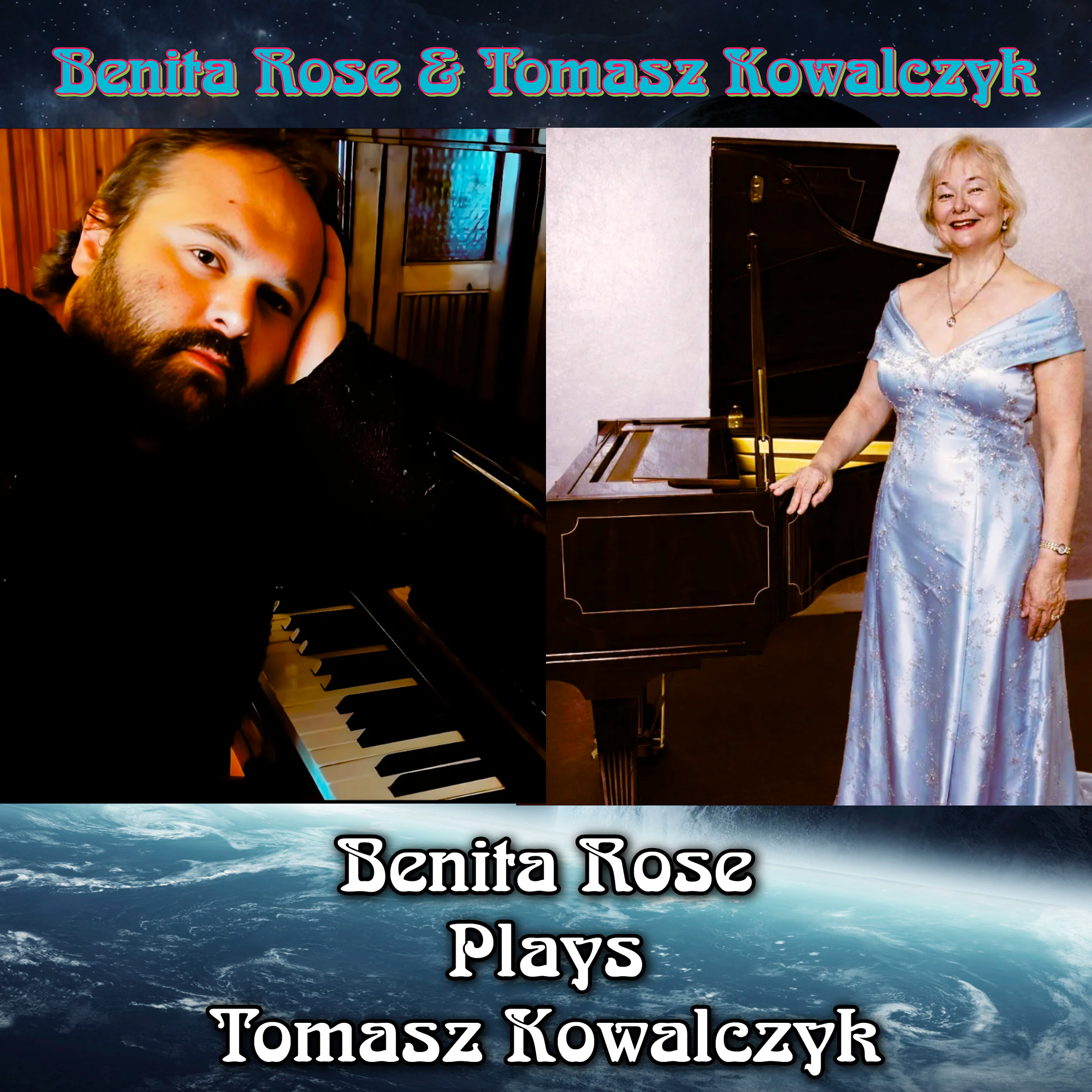
Photo: Tomasz Kowalczyk
Tomasz Kowalczyk | Interview
Tomasz Kowalczyk continues to push the boundaries of contemporary piano composition with a body of work that feels both deeply philosophical and emotionally immersive. With over 30 albums spanning multiple genres, his music explores the idea of “self-dialogue” — a layered, polyphonic conversation that unfolds within the piano itself.
Drawing inspiration from literature, visual art, and the natural world, Kowalczyk creates compositions that feel expansive, intuitive, and richly textured. In this interview, he shares insight into his creative process, the influence of synesthesia, and how collaboration continues to shape his evolving artistic vision.
Your work is described as embracing “self-dialogue” within piano music—how do you approach creating that sense of conversation between voices when composing?
Each voice is a separate and personal spark of my soul, with which I have learned to communicate through the invisible and semantoleptic. A composer—only by resurrecting images and the poetics of the universe—can extract something more than empty, overlapping harmonies with simple scale progressions; this applies to pianists as well. Internal dialogue involves not only using what has been crystallized in the art of composition, but constantly adding new elements, as if the lyrical subject were becoming the addressee. The entire universe is crystallized music—and only within it lies the answer to the most important questions—from where—and why? For as long as I can remember, I have been reaching out in my creations to what surrounds us most closely, because I know that this is pure universalism—a conversation with nature and wildlife is the essence of musical exploration.
You’ve released over 30 albums across multiple genres. What draws you back to solo piano as a central form of expression?
For me, the piano is an absolute instrument, possessing infinite creative possibilities, which I emphasize. Life and nature have given me a gift from the gods to create mine on this wonderful instrument, which can be more lyrical than singing and more powerful than a symphony orchestra’s forte. To create on the piano, one must remember that it is a mirror image of the poetry of the universe. The right hand should be the most exquisite singer, while the left should possess a truly baroque in universal sense—primordial and psychonautical—approach to the core of harmony.
Benita Rose speaks about the “polyphonic universe” in your music. When writing, are you consciously shaping each voice, or does that complexity emerge more intuitively?
My counterpoint, as I’ve already mentioned in part, is my love for Bach and the Baroque period, in which Bach brought him to mastery. Learning to compose takes place between compositions—then there’s time to arrange the appropriate voices within oneself—under specific conditions stemming from experiences, emotions, and specific aspirations. But it’s also time to learn new ones.
During the composing process itself, this happens intuitively; the hands themselves know what the soul desires and when to “ask an additional question” or add a “consistent answer”—even if it might be a “rhetorical question.” Therefore, one could say that it is a work of both elements—rational work and irrational, creative work.
Cinnamon Shops is inspired by The Cinnamon Shops—what was it about that story that resonated with you musically?
“Cinnamon Shops” is a novel published in 1933, written by the Polish genius Bruno Schulz. It tells, primarily in a highly metaphorical way, about our longing for a “lost” world—a loss we ourselves are responsible for. The titular cinnamon shops are small shops, redolent with spices, the wonderful scent of the wood furniture inside, often filled with sweets and freshly baked goods. According to Bruno Schulz, these shops were trampled down, destroyed, and replaced by vast galleries and supermarkets. Schulz, like Vincent van Gogh, felt the stress of the coming civilization, which, as we well know, brought and continues to bring much suffering, for example, through the current race for money. Bruno opposes this, longing to return to what was once shrouded in mystery and to what was “more human.”
Your compositions are often described as blending darkness with light. Is that contrast something you intentionally build into your pieces, or does it reflect your natural creative instinct?
These two energies, like the darkness of black holes and the powerful flashes of quasars in contrast, are apparently considered complementary by my soul. Rather, it emerges from instinct. It’s often said that my compositions in major keys are, or tend to be, sadness. There is no love without tears, and in every sadness we find our way. From mastery can arise routine, and from error, genius.
There’s a strong sense of synesthesia and sensory imagery in how your music is interpreted. Do you personally associate sound with colour, texture, or taste when composing?
Yes, I’m a born synesthete. My neural connections, in particular, have been captivated by sound, which is most often perceived through color, telluric, and textile sensations, but also through illumination—the intoxication of waves. There are also episodes of experiencing taste through sight or touch or smell.

When I was a little boy, still in preschool, I was very surprised by other children’s inability to see the dark blue, navy-purple shades of a cello, or the red of an organ. These were my first encounters with what I call “the gift.”
You’ve collaborated with visual artist Maciej Ciszek on multimedia performances—how does visual art influence the way you think about music?
Maciej Ciszek paints in waves—and his colors form perfect, unique harmonies. These are visual compositions and drawings created through inner song and monastic meditation. It is a canonical art, one that constantly evolves in its own language, but also searches for the undiscovered. Every composer should, and even must, discover painting and literature—without it, they are closed in on themselves, like a fool. Maciej, among visual artists worldwide, is our treasure, one who should be much more appreciated than he is.

Featured artwork by Maciej Ciszek: “I put my fantasy to sleep”
Your music includes signature cadenza-like flourishes that feel almost improvisational. How much of your work is pre-composed versus left open to interpretation in performance?
Improvisation is the purest contact with enlightenment and a form of spirit. I have devoted most of my life to the study of melody, harmony, and counterpoint, which has led me to love incorporating improvised elements into my compositions—based, however, on a constant search for new artistic connotations—not just a pure and empty “journey” through scales, as is often the case in jazz. You could say my compositions are created with the help of divine forces that intuitively reveal new musical micro-universes to me, but beneath this lies a profound preparation and consideration of all the musical components.

As both a composer and a touring pianist, how does performing your own work change your relationship with the music over time?
Playing recitals of one’s own works naturally allows the compositions to evolve. They aren’t repeated over and over again, as a true music creator focuses on the next undiscovered passage, the deepening of harmony, or the creation of new, spectacular forms and textures. This type of conversation with oneself is infinitely enriching. That’s why I’ve lived my life believing that “Music is the language of infinity.”
Your music deserves more than $0.004 per stream… Get our FREE guide – instant download.
With Benita Rose preparing your works for a 2026 world tour, what does it mean to you to hear your music interpreted through another artist’s voice on such a global stage?
Benita Rose, a world-renowned, brilliant pianist, and her playing of my works is my greatest honor. I hear the so-called “old school” in her performances—that is, the fullness of emotion and an understanding of the primal tribalism and essence of each sound. Her playing is similar in vibration to Vladimir Horowitz or Fanny Bloomfield—but she is not a copy of them—her performances bring freshness and uniqueness to the music. Benita Rose stands in opposition to the artificiality of the so-called “historical piano style”—which consistently—for example, through the Chopin Competition—kills individuality and promotes routine, a hollow and mawkish propaganda that glorifies only the accuracy of musical reading. I consider Benita Rose a miracle.
https://www.facebook.com/TomaszKowalczykMusic
https://www.facebook.com/benita.rose.73
https://open.spotify.com/artist/0PE2iCCCk3K8wFgHU1UZuX
https://soundcloud.com/tomasz-kowalczyk-33643833
https://www.youtube.com/@TomaszKowalczykComposer
FVMusicBlog April 2026
If you would like to submit your music for a playlist or review consideration, please submit here.
Also! Check out the awesome other artists on the ‘Discovered This Week’ Playlist!

Leave a Reply