
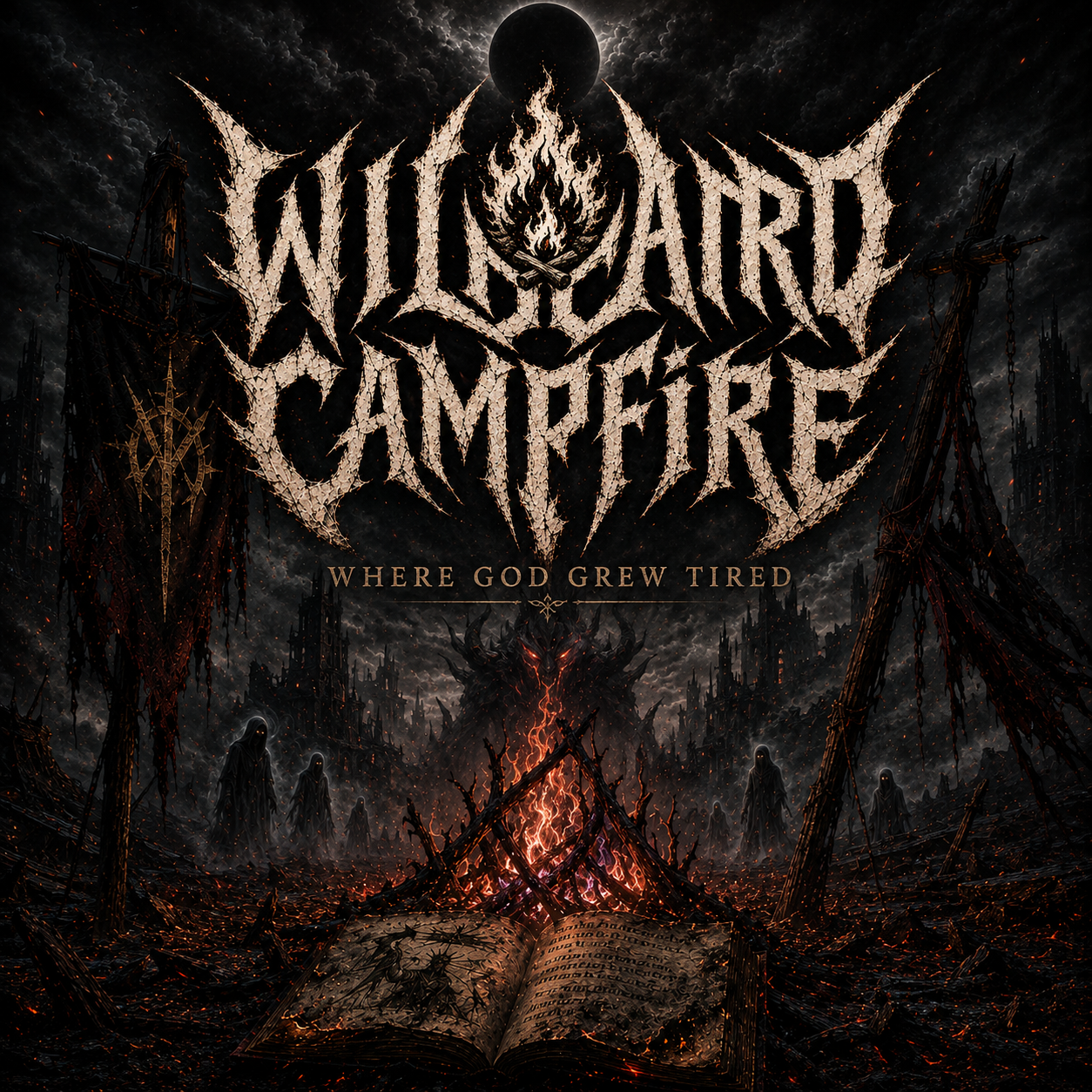
Photo: Wildcard Campfire
Wildcard Campfire Explores ‘Where God Grew Tired’, Songwriting, Storytelling and AI
Wildcard Campfire takes listeners into a world of rebellion, conflict and survival with the debut album, ‘Where God Grew Tired’. Released on 18 September 2026, the ten-track collection combines melodic metalcore, djent, deathcore and cinematic soundscapes to create an ambitious musical experience. Behind the project is songwriter Rom Burla, whose passion for storytelling brings together fictional characters, interconnected histories and deeply personal themes.
From the three-part ‘The Ashen Gospel’ to the emotional weight of ‘The Ghosts of My Past’, each composition offers another perspective on a world shaped by human choices and their consequences. With original guitar-written compositions and generative AI supporting the performance and production stages, Wildcard Campfire also explores an unconventional approach to creating heavy music.
We caught up with Rom to discuss the album’s origins, creative process, personal inspirations and the exciting possibilities awaiting Wildcard Campfire in the future.
‘Where God Grew Tired’ explores a fictional world shaped by rebellion, war, faith and the collapse of civilisation. What inspired you to create this world, and how did the idea first take shape?
There wasn’t really one specific moment when I suddenly decided to create an entire fictional world. It’s something that developed over the years, influenced by the way I look at the world, human behaviour, and things I’ve experienced or witnessed throughout my life.
A lot of the album’s lyrics and musical ideas had already existed in different forms for years. Some came from personal experiences, others from things I observed around me or thoughts about the world we live in.
What especially interested me was taking those experiences and ideas and exploring them through a reality different from our own. I wanted to look at how people behave when they’re afraid, when they’re given power, or when they’re convinced they’re fighting for something righteous, and how their decisions can affect others generations later.
At some point, I started developing the world around those ideas in a more structured way. I built its history, laws, characters, and different factions, trying to understand not only what happens in this world, but why things happen and what consequences they might have in the future.
One of the things I love most about creating a fictional world is the freedom to take something from reality, change its circumstances, and explore it through different characters and situations. Sometimes, by distancing an idea from the real world, you actually start seeing things in it that you hadn’t considered before.
And that’s essentially what I wanted to do with Where God Grew Tired. I didn’t want to create a dark world just for the aesthetic. I wanted to build a place where I could tell stories rooted in real thoughts and emotions, without being limited by what could realistically happen in our own world.
The three-part ‘The Ashen Gospel’ forms the narrative backbone of the album. What made you choose to tell this central story across three separate tracks?
From the beginning, I knew I didn’t want to squeeze the entire history of the world into one massive song, but I also didn’t want every track on the album to be obligated to tell the same central story.
So the trilogy became something of a framework that allowed all the other stories to exist around it.
Each part represents a different stage in the civilisation’s development. Before the Banners Burn deals with the rise of the False Prophet and the beginning of the rebellion. When the Banners Burn shows how those rebellions evolve into wars that continue long after the original leaders have disappeared. And Where God Grew Tired brings the story to the destruction humanity ultimately brings upon itself after thousands of years of conflict.
Splitting the story into three parts allowed me to give each period its own musical identity. There’s a huge difference between the feeling of a world where something is about to erupt, a world already consumed by war, and the moment when everything reaches the point of no return.
I also wanted to connect the three parts musically. For example, a melodic idea introduced at the beginning of the first track returns throughout the trilogy in different arrangements and atmospheres. That way, the music itself evolves alongside the story, not just the lyrics.
And I deliberately placed the three parts at different points throughout the album, rather than presenting them as consecutive tracks.
That gave the other songs room to show different sides of life within the civilisation. We get to know some of the people living through its history, rather than only hearing about the major events that shape it.
So by the time the story reaches its destruction, it’s no longer just about the end of a fictional civilisation. It’s also about losing a world we’ve already had the chance to experience from different perspectives.
You write your lyrics, riffs, melodies and song structures on guitar before using AI during the performance and production stages. Could you walk us through your songwriting process, from the first idea to the finished track?
The process usually begins with an idea for a story, a character, or an emotion I want to communicate. Sometimes I already have lyrics that were written and finished long before I started working on the music, and sometimes I revisit older lyrics and rewrite them into a more mature version during the process.
Once I know what the song is about, I start imagining how it should sound: what musical direction it should take, what atmosphere it needs, and which emotions I want to communicate throughout its different sections.
From there, I pick up my guitar and start developing the riffs and melodies. I work on the song structure, tempo, keys and modes, vocal phrasing, and transitions between sections.
But I’m not just thinking about the notes themselves. I also try to imagine who or what should perform each vocal part and how that decision will affect the listener’s experience.
For example, should a particular section sound like a single voice communicating something intimate, or like a massive choir creating the feeling of an entire crowd singing together? Does it need clean vocals, harsh vocals, a female singer, or perhaps a combination of different voices?
I consider those decisions part of the composition itself. The exact same musical passage can communicate something completely different depending on how the vocals are delivered.
I also plan where solos or instrumental sections should appear, how tension should develop throughout the song, and when the listener needs a moment to breathe.
By that point, I usually have a very clear picture in my head of how I want the finished composition to sound.
Then I use AI for the performance and production stages. I keep working through different versions until I find one that comes close to what I’m hearing in my head, and from there I refine individual sections to bring the result closer to my original vision.
Once I’m happy with the track, I handle the final mastering myself.
The technology currently makes it possible to realise parts of the music I don’t yet have the resources or time to produce traditionally. But it doesn’t replace the creative decisions I make throughout the process.
Ultimately, I want to listen to the finished track and feel that it’s genuinely what I intended to create, rather than just something that happened to sound good.
The album moves between melodic metalcore, djent, deathcore and cinematic post-metal influences. How do you approach choosing the right sound for each song?
I don’t really start writing a song by deciding that it has to belong to a particular genre. Usually, I begin with the emotion and the story, and then try to figure out which sound will communicate them most effectively.
For example, The Beast With My Name takes place at the moment when everything the character has built is beginning to collapse around them. I wanted it to sound aggressive, direct, and chaotic, almost as if the listener is thrown straight into the events without much time to prepare.
The Lowest Point, on the other hand, is a single released before the album that serves as a prequel to The Ghosts of My Past. It’s much more progressive, with a longer and more complex structure, because I wanted to give the character’s emotional development enough room and explore the different states he experiences during his imprisonment.
Then there’s Paradise Has Walls, which takes a much more personal and melodic approach. It’s about two people trying to be together while laws, boundaries, and the world around them keep getting in the way. I wanted the emotional weight of that struggle to come through in the melodies and atmosphere, rather than relying on aggression alone.
Those are three very different songs, but each one uses the musical language that best suits what I wanted to communicate.
I think my influences from heavy, classical, and cinematic music allow me to avoid being restricted by the rigid boundaries of any particular genre.
As long as the song feels like part of Wildcard Campfire’s identity and communicates the feeling I’m looking for, I’m not particularly concerned about which specific subgenre of metal someone decides to put it in.
Tracks such as ‘The Ghosts of My Past’ and ‘Shackles of Blood’ explore guilt, trauma and the lasting effects of violence. What personal experiences or observations influenced these themes?
Some of these themes come from difficult personal experiences that have shaped me over the years, while others come from things I’ve witnessed in other people’s lives or the way I observe human behaviour.
One of the things that stays with me is how the past can continue affecting us long after the events themselves are over. Life moves forward, the world around us changes, but a part of us can remain stuck in something that happened years ago.
That’s a feeling I wanted to explore in The Ghosts of My Past. Within the album’s world, the song continues the story of The Lowest Point, where a character experiences imprisonment that brings him to the lowest point of his life.
There’s something about both parts of that story that feels very close to me personally. The feeling of confinement itself, the loss of freedom, and time seeming to stand still, but also what happens after that confinement ends.
Sometimes the door opens and the world outside continues as if nothing happened, but that doesn’t mean everything you went through stays behind that door. Some experiences continue to follow you long after they’re over, and sometimes you have to learn how to live again without letting your past define everything you are.
That’s what I wanted to communicate through those two songs. The Lowest Point focuses on the character’s experience during his imprisonment, while The Ghosts of My Past explores what remains with him after his release and his struggle to find a way to live again.
Shackles of Blood takes that subject somewhere very different and much more extreme.
Here, we meet a character who has become a perpetrator of violence, committed terrible acts, and now has to live with the consequences of those choices.
To me, there’s a significant moral difference between these characters, and I didn’t want to blur that distinction.
On one side, there’s someone trying to live with the trauma of what he experienced. On the other, there’s someone who can’t escape responsibility for the harm they caused. In both cases, the past continues haunting the present, but the reasons and responsibilities are completely different.
I think the question connecting these stories is how much our past defines us, and whether we’re capable of changing and building a different life despite everything we carry with us.
I’ve shared some of the personal experiences behind these songs, but I don’t necessarily feel the need to explain every detail behind those emotions. I’d rather let the stories remain open to interpretation.
Once I turn something real into fiction, I don’t want listeners to feel that the only way to understand it is through my own life. I’d rather give them the freedom to find something that connects with their experiences, even if their interpretation is completely different from what I originally had in mind.
To me, that’s part of the beauty of music. Two people can listen to the same song, feel completely different things, and both find something real in it.
I don’t think a song needs to be an exact account of my life to be deeply personal. What matters is that the emotion behind it is real, and that it ultimately evokes something in the person listening.
Rather than telling its story in chronological order, ‘Where God Grew Tired’ moves between different voices, memories and historical moments. What inspired you to structure the album this way?
One of the most interesting things about storytelling, to me, is how the order in which we receive information can completely change the way we interpret it.
Sometimes we meet a person or see the outcome of a particular event and form an opinion about what happened. Only later, when we learn what led to that point, do we begin to understand things differently.
That’s something I wanted to bring into the listening experience of Where God Grew Tired.
Instead of taking listeners from the first event to the last, I preferred to introduce them to different voices, characters, and periods, allowing them to gradually discover how everything connects.
I like the possibility that a song might initially sound like a completely self-contained story, but once you become familiar with the world’s history, it takes on another layer of meaning. Suddenly, you can understand what brought a character to their situation, or how a particular idea changed over centuries before reaching the form in which we encounter it.
There’s something about that which reminds me of how memory and history work. We don’t always know all the reasons behind the events whose consequences we’re living with.
At the same time, it was important to me that the track order worked musically. I wanted a listening experience with dynamics, tension, aggressive moments, and room to breathe, rather than one restricted solely by the fictional chronology.
You can listen to the album in its official track order and enjoy it as a musical experience, then revisit it through the story’s chronology and gain a different perspective.
I love the idea that a second listen doesn’t just reveal details you missed the first time, but can actually change the meaning of things you’ve already heard.
‘Khinkali Inferno’ and ‘The Legend of the Shanenigator’ introduce humour and absurdity into an otherwise dark fictional universe. Why was it important to make room for these lighter, more unexpected moments?
Because at the end of the day, even in the darkest possible world, people still need to eat, laugh, and do stupid things!
If I created a world where everyone only suffered, fought, and died for thousands of years, it would eventually start feeling a lot less human.
But there’s also something more to it than just comic relief.
In Khinkali Inferno, for example, we see soldiers taking a break from war to sit together and eat khinkali, a Georgian dish I absolutely love.
There’s something beautiful about people living through something terrible still being able to enjoy food, friendship, and those little moments. For a brief moment, they’re not just soldiers fighting a war. They’re human beings sitting around a table.
And in a way, that makes the war happening around them feel even more tragic, because it reminds us that these people have lives beyond the battlefield, and things they could lose.
The Legend of the Shanenigator comes from somewhere completely different. It was inspired by my young son turning a perfectly tidy living room into a disaster zone within about five minutes of coming home from daycare. I just took that everyday parenting experience and pushed it into completely absurd territory within the album’s world.
I think these moments are important because they allow the world to contain more than one kind of emotion. We don’t stop laughing just because difficult things are happening around us, and sometimes humour is how we deal with them.
For me, those lighter moments don’t take away from the album’s darker atmosphere. They actually make it feel more human.
And besides, I genuinely love humour. Even when I’m writing heavy music with dark stories, I don’t feel the need to take myself completely seriously every single moment.
Wildcard Campfire is a faceless project that places its music and fictional world at the centre of the experience. What does remaining anonymous mean to you as a creative artist?
I wouldn’t necessarily describe Wildcard Campfire as anonymous. My identity as the songwriter is public. It’s the project’s visual identity that I’ve deliberately chosen to keep faceless.
I wanted the music and the worlds I create to be at the centre, rather than necessarily the personality or appearance of the person behind them.
As the project developed, I also realised that this choice gives me a certain amount of creative freedom.
I don’t have to tie every story or character to the way I look or present myself. And if I’m planning to create different worlds along the way, I want the project’s visual identity to be able to change with them.
What fits the dark, apocalyptic world of Where God Grew Tired might not necessarily fit the next world I’m working on.
On the other hand, that decision also creates some interesting challenges.
For example, I’m working on the possibility of releasing guitar and vocal playthroughs, but I’m still figuring out how to do those things while preserving Wildcard Campfire’s faceless aesthetic.
In a more conventional project, I’d probably just set up a camera and start playing, but here I want the way the music is presented to be part of the artistic identity as well.
That doesn’t mean I’m trying to distance myself from listeners. I actually really enjoy talking with them, answering questions, and sharing the creative process.
I just want there to be a distinction between the person creating the music and the world listeners enter when they hear it.
To me, being faceless isn’t the goal of the project. It’s one of the tools that helps me maintain the artistic freedom I wanted from the beginning.

Generative AI plays a role in rendering and performing your original compositions. How do you ensure the finished music reflects your own creative vision?
The most important thing is that I don’t start working with AI without knowing where I want to go.
By the time I use it, I usually already have a very clear picture of the song in my head, including its riffs, melodies, structure, tempo, and vocal delivery.
But just because a generated version sounds good doesn’t necessarily mean it’s right for what I wanted to create.
It might have an amazing riff, but the vocal delivery doesn’t match the emotion I’m trying to communicate. Sometimes all the sections are in the right places, but the transitions between them don’t create the tension or dynamics I had planned.
Those things can make me reject a version even if it sounds great on its own.
When that happens, I keep working. Sometimes that means generating more versions until I find one that gets closer to what I’m hearing in my head, and sometimes it means taking a version that’s already very close and refining individual sections until they work the way I want.
But there’s something else I’ve learned that’s just as important: knowing when to stop making changes.
When you’ve been working on something for a long time, you can always find one more thing that might be worth improving. Sometimes a change genuinely makes the song better, and sometimes it simply makes it different, without necessarily bringing it any closer to what you originally intended.
That’s why I try to give myself some time away from a track and come back to it later. When I return, I try to listen not only as the person who wrote it, but also as someone who simply wants to enjoy the music.
For me, the goal isn’t absolute perfection, because I’m not sure such a thing really exists in art.
It’s about reaching a point where I feel that every part serves the song, and that the finished result is as close as possible to what I wanted to bring to life.
If I can listen to the song from beginning to end and genuinely feel that it communicates what I intended, that’s usually a good sign I’ve reached the right place to stop.
With ‘Where God Grew Tired’ establishing such an extensive fictional universe, what are your ambitions for Wildcard Campfire beyond this debut album?
To me, Where God Grew Tired is the first world of Wildcard Campfire, but I don’t want it to define everything the project will become in the future.
I see A Hymn for the Unburied as the conclusion of the current era. The story has reached a point where I wanted to leave listeners with some open questions, and I don’t feel the need to continue it just to provide definitive answers.
I’ve already started working on the next world, and it’s going to take a very different direction. This time, I want to focus more on human psychology, identity, and how people experience and interpret the reality around them, within a dystopian world with a more clinical atmosphere that begins in the near future.
I’m still in the writing and world-building stages, so I don’t want to commit to every detail or exactly where the story will go.
There are also a few things I still want to do with Where God Grew Tired, including the Lore Book and lyric books, a Deluxe Edition with additional material, and some guitar and vocal playthroughs that I’m trying to figure out how to present while keeping the project’s faceless identity.
Further down the road, I’d love for the project to grow enough for me to work with human musicians and vocalists and bring the music to life organically. And maybe, if things develop in the right direction, even perform it live someday.
I know that could take time. I also have a family and a business to run, and I don’t want to turn the project into a race to release new music every few weeks just to stay active.
What’s most important to me is continuing to enjoy the creative process and not losing sight of why I started making music in the first place.
I want to keep challenging myself, experimenting with new ideas, and creating worlds that allow me to explore different subjects without feeling like I have to repeat what I’ve already done.
My biggest ambition is for Wildcard Campfire to become a project I can keep developing for years, with enough creative freedom for every album and every world to feel like something new while still carrying my musical and artistic identity.
If I can keep creating music I genuinely love, telling stories that mean something to me, and seeing other people find something in them that speaks to them as well, that would mean far more to me than any number of streams or followers.
https://www.facebook.com/wildcardcampfire/
https://soundcloud.com/wildcard-campfire
https://www.youtube.com/@wildcardcampfire
https://www.instagram.com/wildcardcampfire/
FVMusicBlog October 2026
If you would like to submit your music for a playlist or review consideration, please submit here.
Also! Check out the awesome other artists on the ‘Discovered This Week’ Playlist!

Leave a Reply