
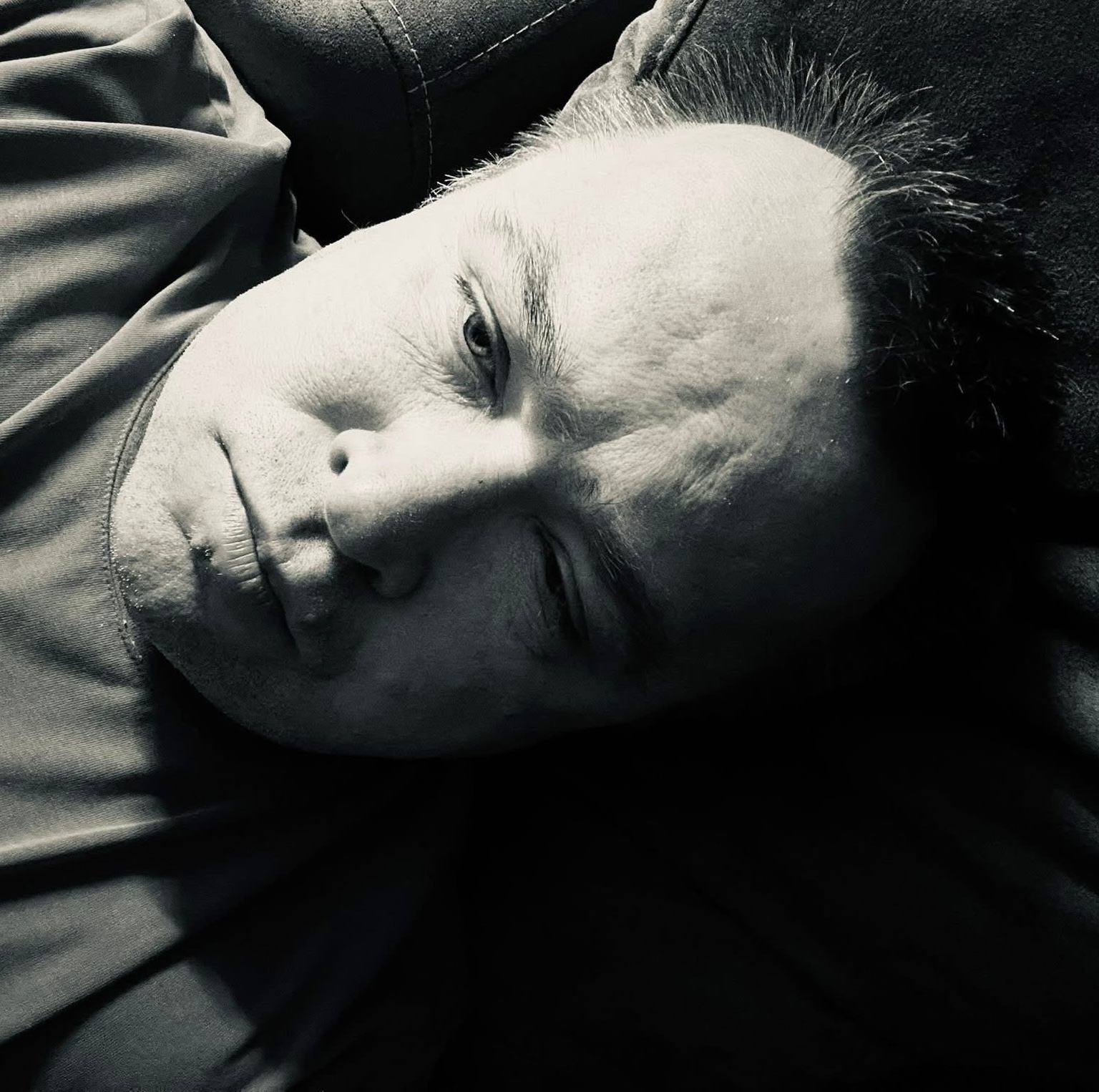
Photo: Dr AdeN HoD
Advertisement Feature
This is a paid promotional feature on FVMusicBlog. The artist has paid for this feature to support the promotion of their release.
Dr AdeN HoD Interview: The Science, Nature and Storytelling Behind ‘Q-NativeIm’
Science, nature and personal expression meet in the music of Dr AdeN HoD, a singer-songwriter, composer and multi-instrumentalist whose creative outlook draws on an international scientific career.
Raised in Yugoslavia / Bosnia and now living in southern Austria, he brings experiences across cultures and disciplines to his album, ‘Q-NativeIm’. Created in Trieste, the project combines acoustic rock, blues, alternative rock and dark folk, with his distinctive baritone voice at its centre. Having written the music and lyrics, performed the instruments and recorded the vocals himself, he approaches songwriting with a commitment to authenticity and organic sound.
In this interview, Dr AdeN HoD discusses the relationship between research and creativity, the childhood landscapes that continue to inspire him, and the philosophy behind the album’s intriguing title. He also reflects on musical individuality, the challenges of independent recording and his ambitions for future projects rooted in genuine human experience and artistic freedom. Read the full review of ‘Q-NativeIm’ here!
Your scientific work involves investigating complex structures and interactions, while your music explores the emotional and philosophical dimensions of life. How does your scientific way of thinking influence the creative decisions you make as a singer-songwriter?
For me, science and music are not opposing worlds. They are different expressions of the same human curiosity.
As a scientist working in the natural and biomedical sciences, nanotechnology, materials science and pharmaceutical research, I have spent much of my professional life investigating complex structures, interactions and the relationships between matter and its environment.
Music allows me to explore similar complexity, but through emotions, intuition and human experience.
Science has taught me to look beneath the surface, question established assumptions and search for the essential nature of things. This approach naturally influences my songwriting.
However, I have never wanted to turn music into a scientific formula. Quite the opposite. My scientific experience has strengthened my appreciation for natural processes, authenticity and even the beauty of imperfection.
In a world increasingly dominated by artificial products and technology, I am drawn to something fundamental: natural sounds, real instruments and genuine human expression.
Science helps me understand the world, while music gives me the freedom to explore what cannot always be measured.
Your international background and life between Austria and Italy offer a distinctive perspective on identity and belonging. How do those different cultural experiences find their way into the music and storytelling of Q-NativeIm?
My cultural identity cannot be reduced to one country or one tradition.
I grew up in Yugoslavia / Bosnia, along the Drina River, surrounded by nature. Those childhood experiences remain deeply connected to my understanding of life, emotions and belonging.
Later, my international scientific career introduced me to different cultures around the world, particularly those of Austria and Italy.
Trieste and the Adriatic region have a special place in my life. I have known nearby Istria since childhood, and the Mediterranean atmosphere has always felt familiar to me.
What fascinates me is how different cultures, languages and traditions meet and influence one another. Even southern Austria, where I live, carries something of that Mediterranean spirit.
These influences appear naturally in my music. I never consciously combine cultures according to a particular formula. They are simply part of who I am.
Although most songs on Q-NativeIm are in English, the album also includes songs in my native language.
When I write a song, it comes from within, spontaneously and without compromise.
For me, music is a place where different cultural identities can coexist without boundaries.
You describe Q-NativeIm as a deeply personal project, bringing together human emotions, relationships and existential questions. What personal experiences or observations provided the strongest inspiration for the album?
The strongest inspiration came from my own life, my relationship with nature and my observations of an increasingly artificial world.
While creating Q-NativeIm, I spent considerable time in Trieste and the Mediterranean region. The Adriatic Sea, the atmosphere of the coastline and memories of growing up close to nature strongly influenced my creative state of mind.
As a scientist involved in applied research, I am particularly aware of environmental questions surrounding synthetic materials, including microplastics and nanoplastics. These questions encouraged me to reflect on our relationship with the natural world.
I began noticing an interesting parallel in contemporary music, where digital programming and artificial production sometimes replace the direct human experience of playing an instrument.
I wanted to move in the opposite direction.
Q-NativeIm became my personal return to something more natural: my own deep voice, real instruments, genuine emotions and the freedom to express myself without unnecessary compromises.
The album also reflects relationships, memories, belonging, uncertainty and the search for meaning.
Ultimately, it is not simply a collection of songs. It is a reflection of who I truly am.
The title Q-NativeIm is unusual and intriguing, offering listeners something to consider before they hear the first song. What meaning does it hold within the wider artistic vision of the album?
Q-NativeIm is my personal play on words, expressing the central philosophy of the entire project.
It combines three elements: Q, Native and I am.
The letter Q represents a symbolic key to the concept, while “Native” stands for something natural, original and authentic. “I am” expresses personal identity.
Together, they represent the idea of returning to my natural self.
I often describe this philosophy as back to nature.
For me, the album is about creating music as I truly am, using my natural baritone voice and predominantly acoustic instruments, with minimal unnecessary artificial intervention.
My scientific background has made me aware of how strongly modern life is influenced by synthetic materials and industrial technologies. Although technology offers extraordinary possibilities, I believe we should also reflect on what we lose when we distance ourselves from natural processes.
I recognize a similar tendency in music production.
Digital technology can be an excellent creative tool, but I wanted to preserve the direct relationship between the musician, the instrument and the sound.
Rather than creating an artificially polished musical identity, I wanted the recordings to retain their organic character.
It is not about rejecting technology, but about placing human expression and authenticity at the centre of artistic creation.
In its simplest form, Q-NativeIm means:
This is my natural self. This is who I truly am.
The album moves through acoustic rock, blues, alternative rock and dark folk, creating space for different moods and textures. How do you discover the musical setting that best serves the story of an individual song?
I usually begin with an emotion, an atmosphere or a musical idea rather than a particular genre.
Sometimes a melody appears first. At other times, it is a phrase, a rhythm or a feeling that I want to express.
I then search for the instrumentation that allows that emotion to develop naturally.
For me, the arrangement should serve the song, not dominate it.
An acoustic guitar may be enough to communicate an intimate story, while another composition may require a stronger blues rhythm, darker harmonies or a more expansive arrangement.
I do not believe artistic expression should be restricted by genre boundaries. Acoustic rock, blues, alternative rock and dark folk are simply different musical languages available to me.
I prefer working with real instruments, preserving the organic interaction between melody, rhythm, harmony and voice.
I also appreciate silence and space within an arrangement. Sometimes what you choose not to play is just as important as what you perform.
Ultimately, I follow the emotional identity of each song and allow it to determine its own musical direction.
Your deep baritone voice is central to your musical identity, particularly within the atmospheric arrangements of Q-NativeIm. How do you approach your vocal delivery to convey the emotional subtleties of a lyric?
My voice is probably my most personal instrument.
I have a naturally deep baritone, and I prefer to preserve its original character rather than imitate a conventional commercial vocal sound.
For me, singing is closely connected to storytelling.
A lyric may express sadness, irony, tenderness, uncertainty or emotional intensity, and each of these requires a different interpretation.
I pay particular attention to phrasing, dynamics and the relationship between the words and the musical atmosphere.
Sometimes a restrained vocal delivery can communicate more than a powerful one.
I also believe that certain imperfections can make a performance more human and emotionally convincing.
My goal is not to achieve technical perfection at any cost, but to communicate something genuine.
I want listeners to hear a human being behind the song, not simply a voice that has been processed until all its natural characteristics have disappeared.
That approach lies at the very heart of the philosophy behind Q-NativeIm.
Nick Cave, Leonard Cohen, John Lee Hooker, Johnny Cash and The Doors are among your musical influences. Each is recognised for a distinctive voice and approach to storytelling. How have their examples helped you develop a musical identity that feels entirely your own?
What I admire most about these artists is not simply their music, but their individuality.
Their work demonstrates that a distinctive voice, powerful storytelling and authentic artistic expression can be more meaningful than technical perfection.
However, influence should never become imitation.
My own musical identity comes from a different combination of experiences: my cultural background, scientific career, relationship with nature and personal approach to composition.
I have never wanted to sound exactly like another artist.
Instead, these musicians have encouraged me to trust the character of my own voice and the stories I want to tell in my own unconventional lyrical style.
I believe originality begins when you stop trying to become someone else.
You created Q-NativeIm in Trieste, writing the music and lyrics, performing the instruments and recording all the vocal parts yourself. What was the greatest creative challenge of translating the sounds in your imagination into a finished recording while working so independently?
The greatest challenge was preserving the original emotional character of the music throughout the recording process.
When you compose, play the instruments and record the vocals yourself, you have considerable artistic freedom, but also responsibility for almost every creative decision.
You constantly move between different roles: singer-songwriter, instrumentalist, vocalist and the person evaluating the overall arrangement.
One difficulty is knowing when a recording is truly finished. You can always add another instrument, change an arrangement or develop the production further.
But I wanted Q-NativeIm to remain organic and relatively minimalist.
I remember that, initially, it was not easy to explain my approach to my sound engineer, Amirotto.
He was accustomed to established mixing and production practices, while I already had a very specific sound in my imagination.
I wanted to follow my inner musical vision rather than conventional production rules. Eventually, Amirotto understood me.
Working in Trieste also gave the project a special atmosphere, shaped by the city, the Adriatic and the surrounding cultures.
Ultimately, my greatest challenge was not making everything sound perfect.
It was making everything sound authentic.
You have previously presented your songwriting through different band projects and now bring your scientific and musical identities together under the name Dr AdeN HoD. What artistic philosophy guides this chapter of your career?
The philosophy behind the name Dr AdeN HoD is based on artistic independence, authenticity and the freedom to explore different dimensions of human experience.
Throughout my life, I have been involved in both scientific research and musical creativity.
For a long time, these activities may have appeared to belong to two separate worlds, but I increasingly recognize them as interconnected parts of my identity.
Science encourages questioning, discovery and the search for understanding.
Music allows me to express emotions, philosophical reflections and personal experiences that cannot necessarily be described through scientific language.
Under the name Dr AdeN HoD, I want to bring these aspects together without separating the scientist from the musician.
Interestingly, friends in my circle once pointed out that some artists use the title “Dr” as part of their stage identity, whereas in my case, it is also an officially earned academic title. That encouraged me to incorporate it naturally into my artistic name, as a symbol connecting two important parts of my life — science and music.
My independent record label, DrahYtime Records, based in Vienna, is also part of this artistic journey.
It represents my intention to develop music according to my own creative vision rather than the expectations of others.
For me, success is not simply about following trends or achieving commercial recognition.
Success means creating something honest that can retain its value over time.

With Q-NativeIm establishing this chapter of your work, what creative directions are you planning to explore in your future musical projects?
Q-NativeIm represents an important artistic statement, but I do not see it as the end of a journey.
I want to continue developing my songwriting while remaining open to different musical influences, arrangements and forms of expression.
My connection with acoustic music, blues and alternative rock will certainly remain important, but I am also interested in exploring new emotional and musical landscapes.
I would like to develop the relationship between poetry, storytelling and instrumental expression even further.
At the same time, my scientific background continues to influence how I think about creativity, technology and the relationship between humanity and nature.
I believe future musical projects can explore these connections in different ways without losing the authenticity that lies at the heart of my work.
Above all, I want to continue creating music that reflects genuine human experience.
I am not particularly interested in chasing temporary trends.
For me, music should remain a form of personal freedom, discovery and communication.
If listeners recognize something of their own lives, emotions or questions in my songs, that is perhaps the most meaningful connection an artist can achieve.
https://www.instagram.com/dr_aden_hod
FVMusicBlog October 2026
If you would like to submit your music for a playlist or review consideration, please submit here.
Also! Check out the awesome other artists on the ‘Discovered This Week’ Playlist!

Leave a Reply